The Nap: Ideal Duration and Sound Ambience for a True Break
How long should a nap last, and what sound ambience helps it truly rest you? Practical guidelines on duration, gentle sounds and a simple nap ritual.
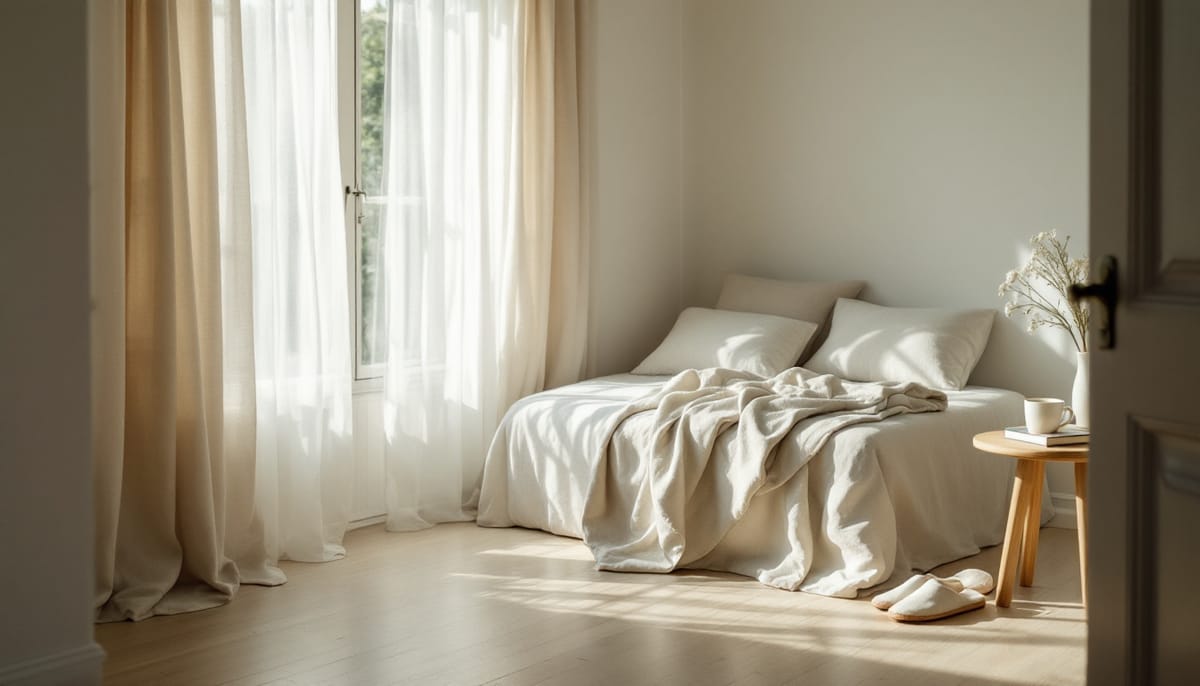
In short — A nap that truly rests you usually lasts 15 to 20 minutes, short enough to avoid a groggy awakening. A calm sound ambience, such as a slow voice, gentle music or natural soundscapes, helps the mind release its attention. Choose the duration before lying down and keep the sound as a background.
Napping has a bad reputation among those who confuse it with laziness. Yet in many cultures, it is an art of living: the Spanish siesta, the Italian riposo, Mediterranean midday breaks, or the ritual rest moments of certain Asian traditions. Far from being a luxury, a nap is a pause we grant ourselves, a moment when we briefly set down the weight of the day. Still, you have to know how to take one: too long, and it leaves a foggy aftertaste; too short, and it doesn't really rest you. And the sound ambience in which you take it changes a great deal. This article offers concrete guidelines, with no medical promises, to make your nap a genuine moment of relaxation.
Why the nap deserves better than its reputation
The nap suffers from a cultural misunderstanding. It is tolerated in children and the elderly, but viewed with suspicion in the active adult, as if lying down for twenty minutes in the middle of the day betrayed a lack of ambition. This view is recent and very Western. In his essay Éloge de la sieste, the philosopher Thierry Paquot reminds us that it was long regarded as a time of civilization, a moment when the collective rhythm is deliberately slowed. The Romans spoke of meridiatio, the midday rest; classical Arab poets sang of the coolness of afternoons spent in the shade. The nap is not an escape: it is a way of reclaiming your own time.
From the standpoint of well-being, it offers above all one simple and precious thing: a break in the continuity of the day. Body and mind change posture, breathing slows, the gaze settles elsewhere. It is a comfort, an airlock for decompression. Nothing more, and that is already a great deal.
What is the ideal duration for a nap that truly rests you?
There is no universal duration, but there are practical guidelines widely shared by those who nap regularly. Three formats are generally distinguished, each with its own logic.
The micro-nap: 5 to 10 minutes
This is the most discreet pause. You close your eyes, relax your shoulders, let a few minutes pass without doing anything. It suits busy days, moments when you cannot really lie down. Its value: marking a clear boundary between two sequences of work, like punctuation.
The short nap: 15 to 20 minutes
This is the format most often recommended for a midday break. Long enough to let the body settle, short enough not to tip into a deep sleep from which you emerge groggy. It is sometimes called a "flash nap" or "power nap" in English-language literature. The idea: stay in that floating zone between wakefulness and sleep, where you still hear the sounds around you but are no longer really thinking.
The long nap: 60 to 90 minutes
Reserved for days off, weekends, or holidays. It allows you to go through a full cycle and wake up more slowly. It does, however, require more availability and a wake-up without a tight time constraint. On weekdays, it can produce a feeling of torpor if you are interrupted abruptly.
The right guideline, in practice: choose your duration before lying down, set a gentle alarm, and respect that frame. A nap is a delimited space, not a drift.
Sound ambience: the invisible setting of the nap
We often prepare for a nap thinking about the mattress, the alarm, the light. We forget sound. Yet it may be the most decisive element in the quality of the pause. A calm sound environment helps release attention; a restless sound environment keeps the mind on alert, even with eyes closed.
Three options present themselves, depending on places and moments.
- Relative silence: ideal if your home is quiet. Close the window, move the phone away, turn off notifications. Silence is never total, but it can be gentle enough to let breathing take over.
- Natural background noise: a window ajar onto a garden, wind in the leaves, a fine rain. These sounds have the advantage of being non-signifying: the mind does not try to decode them.
- A chosen sound ambience: slow music, a reading in a low voice, a composed soundscape. This is where cultural sound relaxation finds its place, offering a sound setting designed for relaxation rather than a random playlist.
In all cases, one principle: sound should accompany, not occupy. If it draws attention, it no longer fulfills its role.
Which sounds to choose for a relaxing break?
Not all sounds are equal. An energetic rock track, a TV series, or a news podcast keep the mind in motion. For a nap, you seek the opposite: sounds that let thought settle.
The slow, steady voice
A reading in a low voice, a short text, a soothing story: the human voice has this particular quality of reassuring without demanding a response. Oral traditions around the world have known this for a long time — evening tales, fireside gatherings, murmured stories. A slow voice, with a steady pace, creates a thread you can hold onto or let go of, as you wish.
Slow instrumental music
Favor slow tempos, soft timbres, continuous textures. Piano, bowed strings, wind instruments played muted. Avoid sudden variations, crescendos, sung voices that catch attention. Music should be a background, not a spectacle.
Natural soundscapes
Distant waves, rain on a roof, a fireplace, a forest at dawn. These ambiences have the advantage of being regular and non-narrative: nothing happens in them, so nothing holds the mind there.
It is in this spirit that Sonocrea, a sound relaxation app, offers sessions that blend a steady voice, texts inspired by the world's wisdom traditions, and gentle musical layers. The approach is cultural: each session draws on a story, an image, a philosophical thought, rather than a simple sequence of sounds. The scripts are original, written in the spirit of these traditions without reproducing their wording word for word.
Creating your nap ritual in practice
A successful nap often comes down to a few simple gestures, repeated.
- Choose a regular moment: after lunch, or in the early afternoon. Regularity helps the body recognize the signal.
- Dim the light: close the shutters, lower the blinds, or use a mask if you don't have a dark room.
- Prepare the sound: start an ambience or a short session before lying down, set a low volume, turn off notifications.
- Set a time limit: a gentle alarm, a gradual wake-up, never a strident ring.
- Plan a buffer on waking: a few minutes sitting, a glass of water, before resuming activity.
These rituals are nothing magical. They work because they are repeated and create a recognizable context: the mind then knows it can release its attention.
Conclusion: a pause on your own scale
A nap is neither a feat nor a weakness. It is a moment you choose, with a duration suited to your day and a sound ambience that leaves room for calm. Fifteen minutes in a dimmed room, a slow voice, gentle music: that is all it takes to turn an ordinary break into a genuine breath in the middle of the day.
If you are looking for a ready-to-use sound setting, designed for relaxation and nourished by literature, music, and philosophy, discover the sessions of Sonocrea at sonocrea.com. There you will find ambiences to start before lying down, at low volume, to accompany your breaks.
Precaution: do not listen while driving; in case of epilepsy or psychiatric disorders, seek a doctor's advice.
Frequently asked questions
What is the ideal duration for a nap?
There is no universal duration, but three formats are common: the micro-nap of 5 to 10 minutes, the short nap of 15 to 20 minutes, often recommended for a midday break, and the long nap of 60 to 90 minutes, better suited to days off.
What sounds should I choose for a relaxing nap?
Favour a slow, steady voice, slow instrumental music with soft timbres, or natural soundscapes such as distant waves or rain on a roof. Avoid energetic tracks, series and news podcasts, which keep the mind in motion. Sound should accompany, not occupy.
How do I create a simple nap ritual?
Choose a regular moment, dim the light, prepare a calm sound ambience at low volume and turn off notifications. Set a gentle alarm and plan a few minutes of buffer on waking, with a glass of water, before resuming activity.
Read also
Découvrez Sonocrea
Créez vos propres séances de bien-être sonore avec notre IA. Fréquences binaurales, hypnose audio et sons ambiants personnalisés.
Essayer gratuitement →