The oud and maqams: listening to Arabic music to settle
The oud and the maqams offer a rich listening ground for settling at the end of the day. Here is how to listen to Arabic music with calm attention.
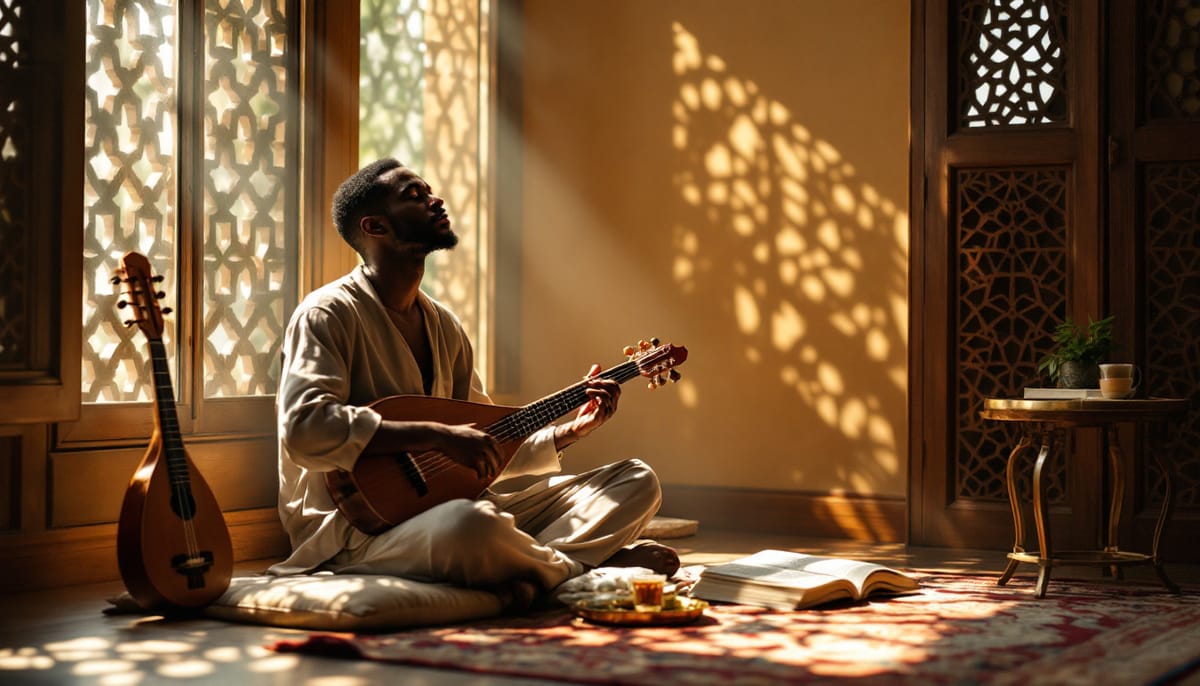
In short — The oud is a travelling lute whose veiled timbre and the maqams' melodic phrases invite slow, attentive listening. No theory is needed: follow the phrases, breaths and silences to settle into a moment of calm.
Music that invites you to slow down
Some music does not seek to fill the space, but to open it. The oud, a plucked-string lute with a teardrop-shaped body, is one of them. Its low, slightly veiled timbre seems made for the end of the day: you rest the instrument on your knees, brush the strings, and time begins to breathe differently.
In the cultural sound relaxation offered by Sonocrea, we seek neither performance nor spectacular effect. We listen to music that has crossed the centuries, carried by poets, musicians and singers, and we let it soothe us. The oud and the maqams — those melodic modes of Arabic music — offer a listening ground of rare richness. Not to "heal", but simply to settle, listening to what is most human in these traditions.
The oud: a travelling instrument
The oud is one of the oldest lutes still played. It is found from the Maghreb to the Arabian Peninsula, from Turkey to Iraq, and as far as Iran in closely related forms. Its name, often linked to the Arabic word for wood or stick, recalls its material: assembled strips of wood, a soundboard, a short neck and numerous pegs. Its round, slightly matte sonority comes from its bulging body and its strings plucked with a plectrum.
What strikes you on listening is the way the instrument supports the voice rather than dominating it. In the tradition of the Iraqi maqam, inscribed on UNESCO's intangible cultural heritage list, the singer unfolds long melodic phrases, accompanied by an ensemble in which the oud holds a discreet and essential place. One also thinks of the Egyptian wasla, sung suites in which the instrument dialogues with the orchestra.
Performers such as Munir Bashir, Nassima Châabane and Anouar Brahem have each explored the instrument in their own way, between tradition and personal writing. Listening to their recordings is already to enter a form of calm: few block chords, much silence, a melodic line that moves forward without hurrying.
Understanding maqams without studying them
The maqam is often described as a scale of notes, but it is much more than that: it is a way of moving between sounds, with intervals that do not always correspond to those of the European scale. Some maqams have a melancholy colour, others a more vivid tension, others still an almost suspended sweetness. They are distinguished by their sayr, that is, their path: the order in which the notes are visited, the note on which one lingers, the one to which one returns.
For the listener, there is no need to know the theory. What matters is to notice that the music unfolds in phrases, with breaths, returns and ornaments. The maqam Rast, often associated with a certain serenity, opens many pieces; the maqam Bayati, frequent in popular songs, has a more intimate colour; the maqam Hijaz sometimes evokes a nostalgia found in wedding songs as well as in laments.
This listening connects with other traditions around the world, each with its own vocabulary. In North India, ragas also organise time and atmosphere, with ascending and descending phrases and a held note that serves as a centre. In Japan, the shakuhachi plays on breath and silences, in an aesthetic where the interval counts as much as the note. On the edges of the Sahel, the ngoni and the kora weave repeated motifs that rock the ear. These connections are not meant to blur the traditions together, but to recognise the same attention paid to the musical gesture and to the breathing it induces.
Listening differently: a simple practice
Here is how we like to offer this listening, with no special equipment and no expectation of a result. The idea is to create a moment of comfort, not a performance.
- Choose a moment: at the end of the day, or after a walk. Avoid times when you need to remain available to others.
- Settle in: an armchair, a mat, a cushion. Back supported, shoulders low, hands resting.
- Listen to a short piece: a solo oud improvisation, for example, or a ten-minute wasla. Better to listen to a little attentively than a lot distractedly.
- Follow the phrase: notice the moment when the melody rises, the one where it descends, the silences between phrases. That is where the body slows down.
- Come back: if your attention wanders, simply return to the timbre of the instrument, without judgement.
In a library, someone may listen to a recording of an Iraqi maqam while leafing through a collection of Arabic poetry; in a living room, another prefers a solo oud piece, doing nothing else. Both gestures are equally valid. The essential thing is to let the music occupy the space without trying to understand it entirely.
Poetry, memory and presence
Arabic music is inseparable from its poetry. The sung qasidas, the Andalusian muwashshah, the songs of the Maghrebi nawba carry texts in which love, absence and the beauty of the world answer one another. To listen to a maqam is often to listen to a poem set to voice. One thinks of the Andalusian poet Wallada bint al-Mustakfi, whose verses have crossed the centuries, or of the Egyptian singer Oum Kalthoum, whose long improvisations have marked generations. Among men, the pre-Islamic poet Imru' al-Qays and the singer Mohammed Abdel Wahab have also shaped an imaginary of song and speech.
This alliance of text and sound is found elsewhere too. In West Africa, griots and griottes pass on stories accompanied by stringed instruments, where speech is carried by a rhythm. In India, dhrupad and khayal develop devotional poems over precise rhythmic cycles. In East Asia, the Chinese guqin zither sometimes accompanies singing and recitation. Everywhere, music offers a frame in which speech can settle and in which the listener can settle too.
At Sonocrea, we draw on these wisdoms of the world to create original scripts for guided listening: never word-for-word translations, but evocations that respect the spirit of the traditions. The sound relaxation app offers sessions in which the oud, the maqams and other world music serve as a thread through a moment of calm.
Conclusion: settling, without hurrying
The oud and the maqams ask nothing more than our attention. They promise neither healing nor spectacular transformation: they offer a space where the musical phrase breathes, where the voice settles, where silence has its place. It is an invitation to relaxation, to curiosity, to an encounter with works and artists that have crossed the ages.
If you would like to discover listening sessions inspired by these traditions, visit sonocrea.com and explore the cultural sound relaxation journeys. Take the time to try a short piece, then another, and let your ear grow accustomed to these melodic colours.
Precaution: do not listen while driving; in case of epilepsy or psychiatric disorders, seek a doctor's advice.
Frequently asked questions
What is a maqam in Arabic music?
A maqam is more than a scale of notes: it is a way of moving between sounds, with intervals that do not always match the European scale. Each maqam has its own colour and sayr, the path by which its notes are visited.
How can I listen to the oud to relax?
Choose a quiet moment, settle with your back supported, and listen to a short solo oud improvisation or a ten-minute wasla. Follow the phrases, notice where the melody rises and falls, and return gently to the timbre when attention wanders.
Do I need to know music theory to enjoy maqams?
No. The article explains that listeners need not study the theory: what matters is noticing that the music unfolds in phrases, with breaths, returns and ornaments, and letting the sound occupy the space without trying to understand it entirely.
Read also
Découvrez Sonocrea
Créez vos propres séances de bien-être sonore avec notre IA. Fréquences binaurales, hypnose audio et sons ambiants personnalisés.
Essayer gratuitement →