The Armenian Duduk: A Breath That Soothes
The Armenian duduk is an apricot-wood pipe whose continuous, voice-like breath invites relaxation and attentive listening. Here is how to approach it with calm.
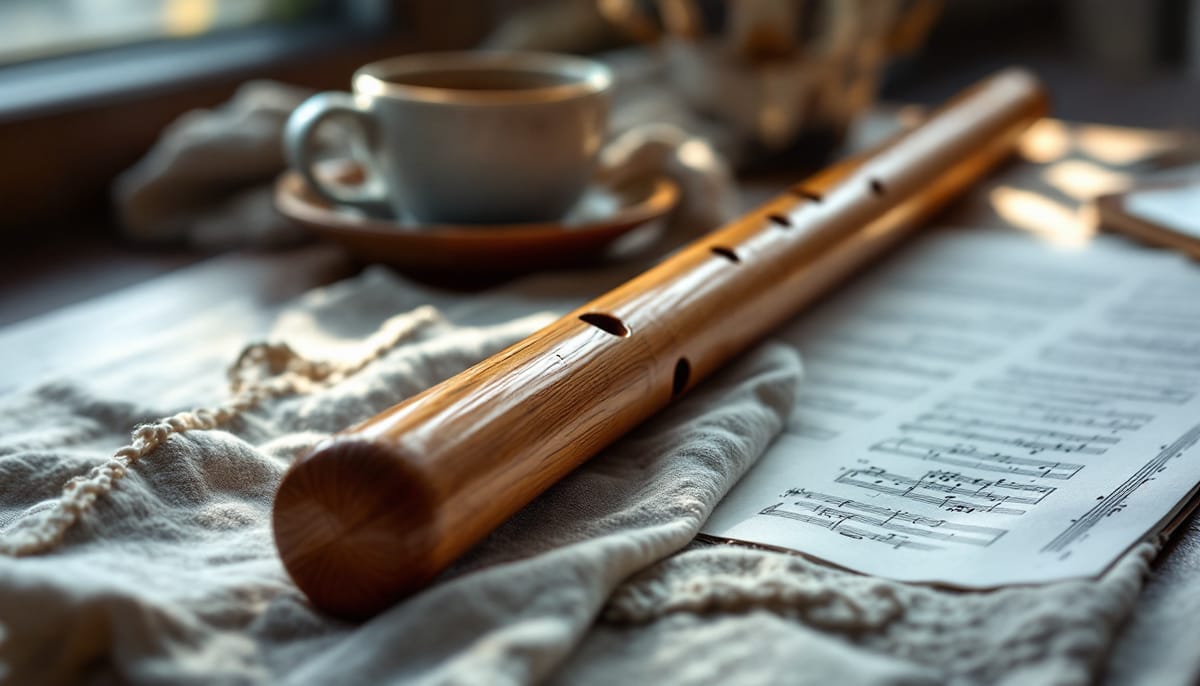
In short — The Armenian duduk is an ancient apricot-wood wind instrument with a double reed, played with circular breathing so its voice seems continuous. Its simple, rounded timbre invites slowing down, calm listening and cultural curiosity rather than any spectacular promise.
There are instruments that do not seek to fill the space, but to soften it. The Armenian duduk belongs to this rare family: a simple apricot-wood pipe, pierced with a few holes, blown through a double reed. The sound that emerges resembles a voice that has renounced speech to keep only the breath. It is precisely this bareness that makes it a precious companion for relaxation, attentive listening and what we at Sonocrea call cultural sound relaxation: a way of settling oneself, rooted in literature, music and philosophy, far from any spectacular promise.
An instrument born of patience
The duduk is a very ancient wind instrument, whose closest forms have circulated for centuries in the Caucasus and the Near East. In Armenia, it holds a special place: it is found at village celebrations as well as in the great pages of art music. Its making, however, tolerates no haste. The body is carved from apricot wood, renowned for its softness and its ability to carry a warm timbre. The reed, cut from a fine cane, demands a jeweler's work: too thick, it stifles; too thin, it cries out.
This slowness of making is already a lesson in listening. Before producing a sound, the instrument has required hours of patient attention. One thinks of those luthiers who, from Japan to Andalusia, repeat that one does not make an instrument, one accompanies it. The duduk, like the Arab oud or the Mandinka kora of West Africa, reminds us that music begins well before the first note: in the gesture of the one who prepares the material.
What the breath does to the body
To listen to a duduk is first of all to notice its breathing. The instrument does not produce detached sounds like a transverse flute: it sings continuously, thanks to a circular breathing technique that allows the musician to sustain the note without apparent interruption. The listener then perceives a seamless melodic line, close to the human voice.
This continuity invites slowing down. In a day saturated with notifications, the duduk offers the opposite of a stream: a single voice that takes its time. One can listen to it with eyes closed, while reading, walking slowly, or simply sitting near a window. The relaxation sought here has nothing magical about it: it comes from the simplicity of the timbre, its roundness, its absence of aggressiveness in the high register.
This relationship to breath is not unique to Armenia. In North India, the bansuri, a bamboo flute dear to the Hindustani tradition, also plays on breathing and the silence between phrases. In Japan, the shakuhachi flute, stemming from the repertoire of itinerant monks, cultivates an aesthetic of fragile breath and emptiness. In West Africa, the balafon and the kora remind us that the gentle repetition of a melodic cell can also soothe. These traditions are not to be confused; each has its history, its vocabulary, its rules. To name them precisely is to refuse easy exoticism and to recognize a shared attention to listening.
A voice in books and on stages
The duduk owes much to one man: Djivan Gasparyan, who carried it from the Caucasus to international stages and gave it worldwide visibility. But it would be unfair to forget the women musicians who, today, take up the instrument and broaden its repertoire, in chamber ensembles as well as in contemporary creative projects. Transmission, in Armenia, often passes through families and conservatories, and women are taking an ever-growing place there.
Literature is not left out. In Armenian narratives, the sound of the duduk accompanies evening gatherings, departures, reunions. The same trust in the sung word is found among the poetesses of the Arab and Persian world, whose verses were long carried by voice and instrument, or among the storytellers of West Africa who make the rhythm of the sentence a place of rest. The musicologist and philosopher Lydia Goehr, like the thinker Theodor Adorno before her, have written about what music does to our attention: not a mechanical effect, but an experience of form, time and memory.
This idea also runs through the Americas. The indigenous peoples of the northern plains as well as the Andean communities have developed flutes and songs in which breath is central, often linked to the season, the wind, collective work. Here again, it is not a matter of copying a ritual, but of recognizing an intelligence of sound that our urbanized ears have sometimes forgotten.
Listening to the duduk today: a few concrete pointers
There is no need to be a music lover to enter into this listening. A few pointers are enough:
- Choose the right moment. The duduk pairs well with the end of the day, reading, preparing a meal or a calm commute on public transport.
- Favor a moderate volume. The timbre is rich in midrange; too high a volume tires the ear and loses the sought-after softness.
- Alternate with silence. Listening to three pieces and then stopping allows one to savor the inner resonance, a little as one lets tea steep.
- Discover the neighbors. After the duduk, one can explore the oud of the Arab world, the Persian ney, the Indian bansuri or the Japanese shakuhachi: each instrument offers another way of breathing.
It is in this spirit that Sonocrea, a sound relaxation app, offers sessions built like listening walks: original scripts inspired by the world's wisdom traditions, without word-for-word quotation, where the voice accompanies the music rather than commenting on it. The goal remains modest and clear: to offer a moment of comfort, calm and cultural curiosity.
An art of attention rather than a promise
The duduk repairs nothing, claims nothing. It offers an aesthetic experience: a wooden voice that holds a note, for a long time, and leaves us the time to settle into it. In an era that values performance, this slowness is almost a luxury. It recalls what philosophers of music, men and women alike, have never ceased to say: to listen is already to take care of one's attention.
So, the next time a day seems too dense, try this: close the tabs, set the phone at a distance, and let a duduk sing for a few minutes. You will have gained nothing, resolved nothing — and that is perhaps exactly what was needed.
To explore guided listening sessions and musical atmospheres from around the world, visit sonocrea.com and discover the Sonocrea library.
Caution: do not listen while driving; in case of epilepsy or psychiatric disorders, seek a doctor's advice.
Frequently asked questions
What is the Armenian duduk made of?
The duduk's body is carved from apricot wood, valued for its softness and warm timbre. Its reed is cut from fine cane and requires delicate, patient work: too thick it stifles, too thin it cries out.
Why does the duduk sound continuous?
The musician uses circular breathing, which allows the note to be sustained without apparent interruption. The listener perceives a seamless melodic line, close to the human voice, which invites slowing down and calm attention.
How can I listen to the duduk for relaxation?
Choose a calm moment such as the end of the day or while reading, keep the volume moderate, alternate pieces with silence, and then explore neighbouring instruments such as the oud, ney, bansuri or shakuhachi.
Read also
Découvrez Sonocrea
Créez vos propres séances de bien-être sonore avec notre IA. Fréquences binaurales, hypnose audio et sons ambiants personnalisés.
Essayer gratuitement →