Tibetan Bowls: History, Culture and Sound Relaxation Practice
Tibetan bowls have Himalayan roots and a rich harmonic sound. Explore their history, how they work, the main types of bowls and how to practise sound relaxation at home.
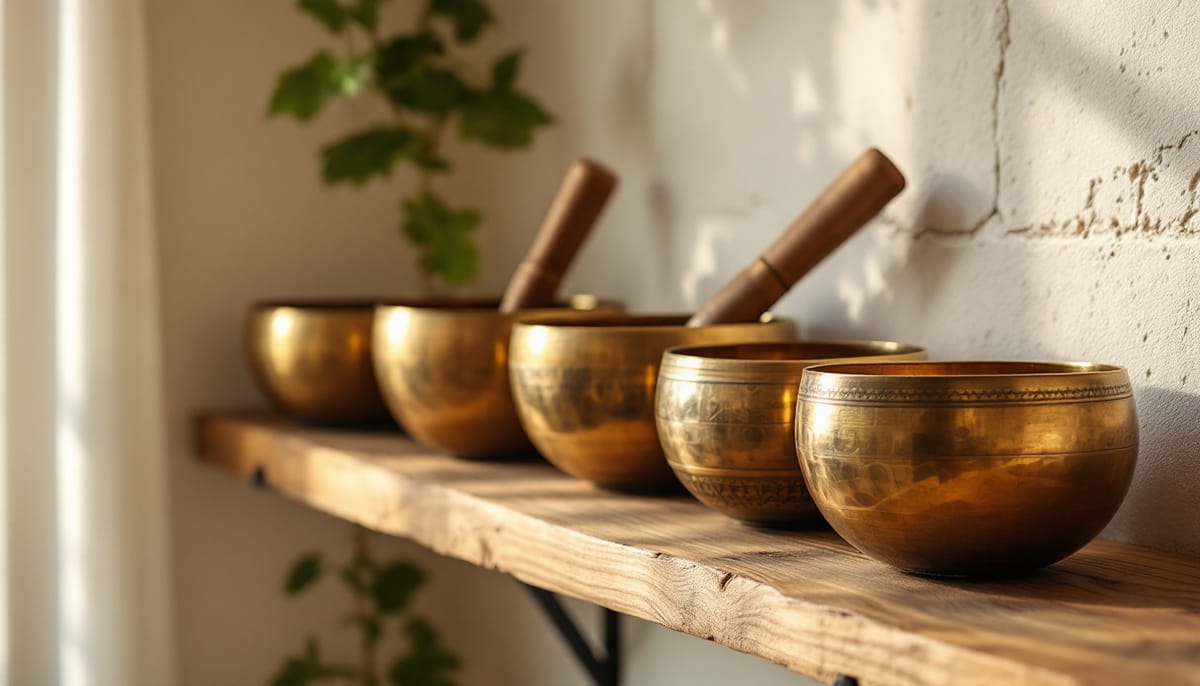
In short — Tibetan bowls, found across the Himalayan region, are metal bowls that emit a fundamental tone with rich harmonics when struck or rubbed. Their vibrations are felt as a gentle resonance, and they are used for relaxation and calm. Sonocrea reproduces their harmonic patterns in digital compositions.
Origins and history of Tibetan bowls
Contrary to their name, singing bowls are not exclusively Tibetan. They are found throughout the Himalayan region — Nepal, Bhutan, northern India — as well as in Central Asia. The earliest written references date back to the 11th century, although oral tradition suggests a much earlier use in pre-Buddhist Bön shamanic practices.
Traditionally, the bowls were made from a seven-metal alloy, each associated with a celestial body: gold (Sun), silver (Moon), copper (Venus), iron (Mars), mercury (Mercury), tin (Jupiter), lead (Saturn). This complex metallurgical composition produced particularly rich harmonics.
How do Tibetan bowls work?
When a bowl is made to vibrate — by rubbing the mallet along the rim or by striking it — it emits a fundamental tone accompanied by numerous harmonics (whole-number multiples of the fundamental frequency). This harmonic richness is precisely what distinguishes them from modern instruments.
On a physical level:
- Vibrations travel through the air as pressure waves
- In direct contact with the body, they create subtle micro-vibrations
- These vibrations can be felt as a gentle resonance in the chest and ribcage
- The experience is often described as soothing and immersive
What science says
Research on Tibetan bowls has accelerated since 2010. Here are the most significant findings:
- ✅ Altered states of consciousness: Increase in Theta and Alpha waves measured by EEG during and after sessions.
Types of bowls and their uses
Neptune bowls (low-pitched)
Large bowls with low frequencies (80-200 Hz). Ideal for deep relaxation, pain relief and work on the physical body.
Saturn bowls (medium-pitched)
Medium frequencies (200-500 Hz). Balance, grounding, emotional work.
Mercury bowls (high-pitched)
Small bowls with high frequencies (500 Hz-2 kHz). Mental clarity, concentration, spiritual awakening.
Practicing at home: beginner's guide
- Positioning: Hold the bowl in an open palm (not gripped, so as not to stifle the vibrations)
- The mallet: Start with a light strike, then slowly rub the outer rim with constant pressure
- Pressure: Neither too light (sound too faint) nor too strong (sound strident). Look for the "sweet spot"
- Frequency: At least 3 times a week for cumulative effects
Digital sound relaxation with Sonocrea
While physical bowls offer incomparable richness, their accessibility remains limited. Sonocrea uses AI to reproduce the harmonic patterns of Tibetan bowls and integrates them into personalized compositions, available immediately on your phone.
Sonocrea is a relaxation and comfort tool, not a medical device: it does not replace medical advice or care. Do not listen while driving or during any activity that requires alertness. If you have epilepsy or a psychiatric condition, ask a doctor first.
Frequently asked questions
Are Tibetan bowls really from Tibet?
Not exclusively. Singing bowls are found throughout the Himalayan region, including Nepal, Bhutan and northern India, as well as in Central Asia. The earliest written references date back to the 11th century, though oral tradition suggests earlier use in pre-Buddhist Bön practices.
How do Tibetan bowls produce sound?
When a bowl is struck or rubbed with a mallet, it emits a fundamental tone accompanied by numerous harmonics, which are whole-number multiples of the fundamental frequency. This harmonic richness is what distinguishes them from modern instruments.
How can I start practising with a Tibetan bowl at home?
Hold the bowl in an open palm without gripping it, start with a light strike, then slowly rub the outer rim with constant pressure. Find a pressure that is neither too light nor too strong, and practise at least three times a week for cumulative effects.
Read also
Découvrez Sonocrea
Créez vos propres séances de bien-être sonore avec notre IA. Fréquences binaurales, hypnose audio et sons ambiants personnalisés.
Essayer gratuitement →