Guided Visualization: Principles and Best Practices
Guided visualization is a simple relaxation practice that uses a voice to lead you through imagined scenes. This article explains its principles, origins, and how to practice it well.
In short — Guided visualization is a relaxation practice where a voice leads you to imagine a calming scene. It relies on a slow pace, sensory images, and a clear structure. The goal is not to achieve results but to enjoy a moment of comfort and presence.
Closing your eyes and letting a voice carry you elsewhere: guided visualization is one of the most accessible relaxation practices there is. It requires no special equipment, just a quiet place and a few minutes for yourself. Yet behind this apparent simplicity lies a precise art, nourished by centuries of storytelling, poetry, and reflection on attention. In this article, we explore what guided visualization really is, where it comes from, and how to practice it well, expecting nothing more from it than a moment of comfort and presence.
What is guided visualization?
Guided visualization consists of letting yourself be led, by a voice or a text, toward an imagined scene: a garden, a shoreline, a quiet library, a country path. The principle is simple: attention gently turns away from the demands of daily life to settle on mental images, sensations, and a fuller rhythm of breathing. It is not about absolutely "seeing" something, but rather about letting impressions, colors, textures, and inner sounds come to you.
This practice belongs to a long tradition of immersive storytelling. The storytellers of evening gatherings, the poets of antiquity describing landscapes, the novelists who make us feel the wind on a moor: all of them exercise a form of guidance of the imagination. Guided visualization takes up the principle but turns it entirely toward relaxation. There is no lesson or moral to be sought, only a quality of presence.
It is worth emphasizing from the outset what it is not: it is neither a medical technique nor a performance tool. It is a wellness practice, a space for respite. This clarification protects the practice as much as it protects those who try it.
The principles of a good visualization
A slow pace and a steady voice
The first quality of a guided visualization is its tempo. A voice that is too fast, too many instructions, and attention scatters. Experienced guides leave silences, gently repeat an instruction, return to the breath. This slow pace is not a detail: it gives the mind time to settle into the image rather than chase it.
Concrete, sensory images
A good visualization favors simple sensations: the coolness of a stone, the scent of wet grass, the steady sound of a wave. Images that are too abstract or too busy leave the mind perplexed. Conversely, a precise, uncluttered scene — a bench, a tree, a sky — offers a clear anchor for the imagination.
No demand for results
You do not "succeed" at a visualization. Some sessions will be rich in images, others blurrier, sometimes punctuated by wandering thoughts. That is normal. The principle is to welcome what comes, without judging, and to return patiently to the suggested scene. This kindness toward yourself is an integral part of the practice.
A clear framework: beginning, middle, end
A well-constructed session has a threshold: you settle in, breathe, close your eyes. Then a heart: the scene unfolds. Finally a return: you gradually come back to the room, to the sounds around you, to your body. This reassuring framework allows you to let go without feeling "lost."
Where does this practice come from?
Guided visualization, as practiced today in a relaxation context, draws on several sources. You can find in it the art of storytelling, where the listener is carried by a voice and mentally builds worlds. You can also hear the echo of the philosophical tradition of attention: the Stoics, for example, invited people to return regularly to the present moment and to what depends on us. Closer to our time, literary fiction has shown how much a precise description can soothe as much as move.
Music also plays an important role. A soft instrumental layer, a steady rhythm, a warm timbre: these elements support the imagination without constraining it. It is in this spirit that Sonocrea offers cultural sound relaxation sessions, where voice and music come together to create a space of calm inspired by the stories and landscapes of the world.
Best practices for a successful session
- Choose a suitable time and place: a quiet spot, soft light, a phone on silent. Fifteen to twenty minutes are enough for a first experience.
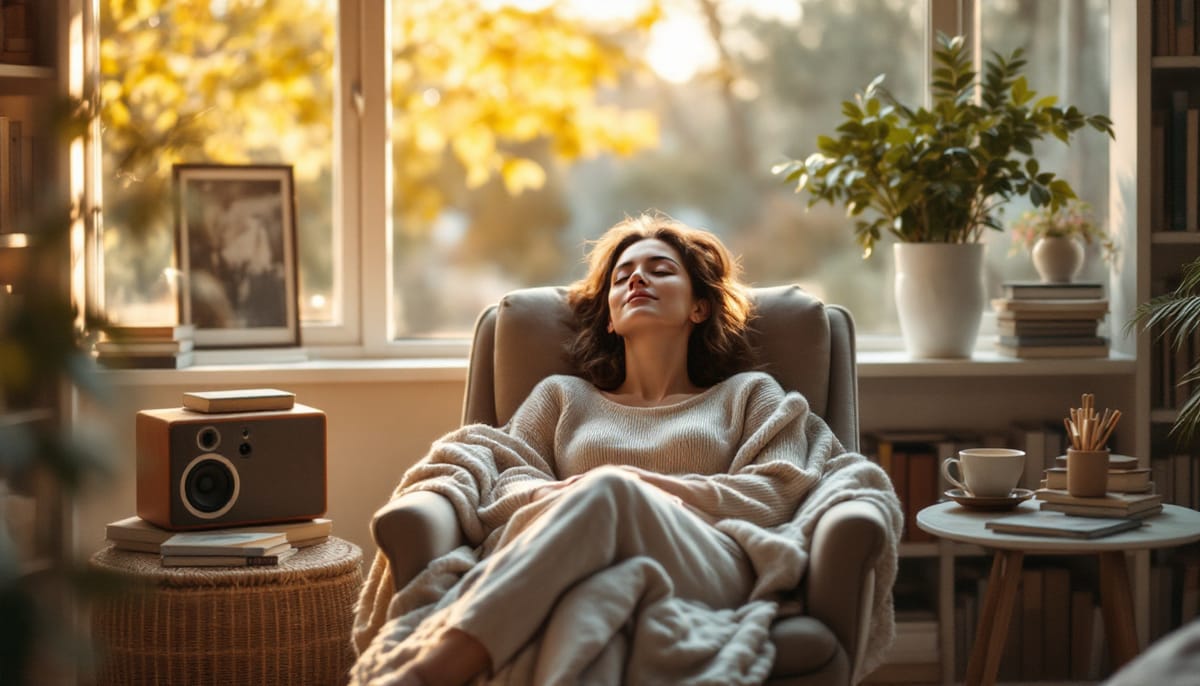
- Settle in comfortably: seated in an armchair or lying down, your body supported, without unnecessary tension. A blanket can help you stay warm and feel enveloped.
- Begin with the breath: a few full breaths, without forcing, to mark the transition from daily life to the session.
- Welcome images without forcing them: if a scene does not come, rely on the sensations suggested by the voice (the contact of the ground, the temperature of the air).
- Do not worry about passing thoughts: notice them and gently return to the thread of the guidance, without reproaching yourself for anything.
- Plan a gradual return: at the end, gently move your fingers, open your eyes, reconnect with the room before getting up.
- Keep a regular rhythm: the practice becomes easier when it becomes a gentle habit, a few times a week, without obligation.
It is also helpful to vary the atmospheres. Some prefer natural landscapes, others warm interiors, still others stories inspired by the world's wisdom traditions. Sonocrea offers original scripts, written in this spirit, without seeking to impose a single way of doing things. Everyone can find a tone that speaks to them.
What to do if you "drift off"?
It is common to lose the thread, fall asleep, or start thinking about your day. Rather than seeing this as a failure, you can consider these moments as part of the relaxation. Simply having granted yourself a pause remains beneficial. You pick up the guidance wherever you are, without trying to make up for lost time.
Do you need a guide, or can you practice alone?
Both are possible. Listening to a recorded voice makes immersion easier and avoids having to remember the steps. Practicing alone, by rereading a text or recalling a familiar scene, develops autonomy. The essential thing is to choose what makes you most comfortable.
Conclusion
Guided visualization is a simple invitation: to grant yourself a moment to let your mind inhabit a landscape, a room, a soothing memory. Its principles — slowness, concrete images, kindness, a clear framework — make it accessible to everyone, as long as you expect only a little comfort and presence from it. To discover original sessions inspired by literature, music, and stories from around the world, you can explore the Sonocrea app at https://sonocrea.com and find the atmosphere that suits you.
Precaution: do not listen while driving; if you have epilepsy or psychiatric disorders, seek a doctor's advice.
Frequently asked questions
What is guided visualization?
Guided visualization is a relaxation practice where you let a voice or text lead you toward an imagined scene, such as a garden or shoreline. Attention turns away from daily demands to settle on mental images, sensations, and breathing, without needing to 'see' anything clearly.
How long should a guided visualization session last?
The article suggests that fifteen to twenty minutes are enough for a first experience. A well-constructed session includes a beginning, middle, and end, allowing you to settle in, explore the scene, and gradually return to the room.
What if I drift off during a guided visualization?
It is common to lose the thread or fall asleep. Rather than seeing it as a failure, consider these moments as part of the relaxation. Simply having granted yourself a pause remains beneficial. You can pick up the guidance wherever you are, without trying to make up for lost time.
Read also
Découvrez Sonocrea
Créez vos propres séances de bien-être sonore avec notre IA. Fréquences binaurales, hypnose audio et sons ambiants personnalisés.
Essayer gratuitement →