Katajjaq, Inuit Vocal Game: The Voice as Landscape
Katajjaq is a traditional Inuit women's vocal game where two partners exchange breath-driven rhythms face to face. Its gestures of breath, pulse and listening offer lessons in shared attention and calm.
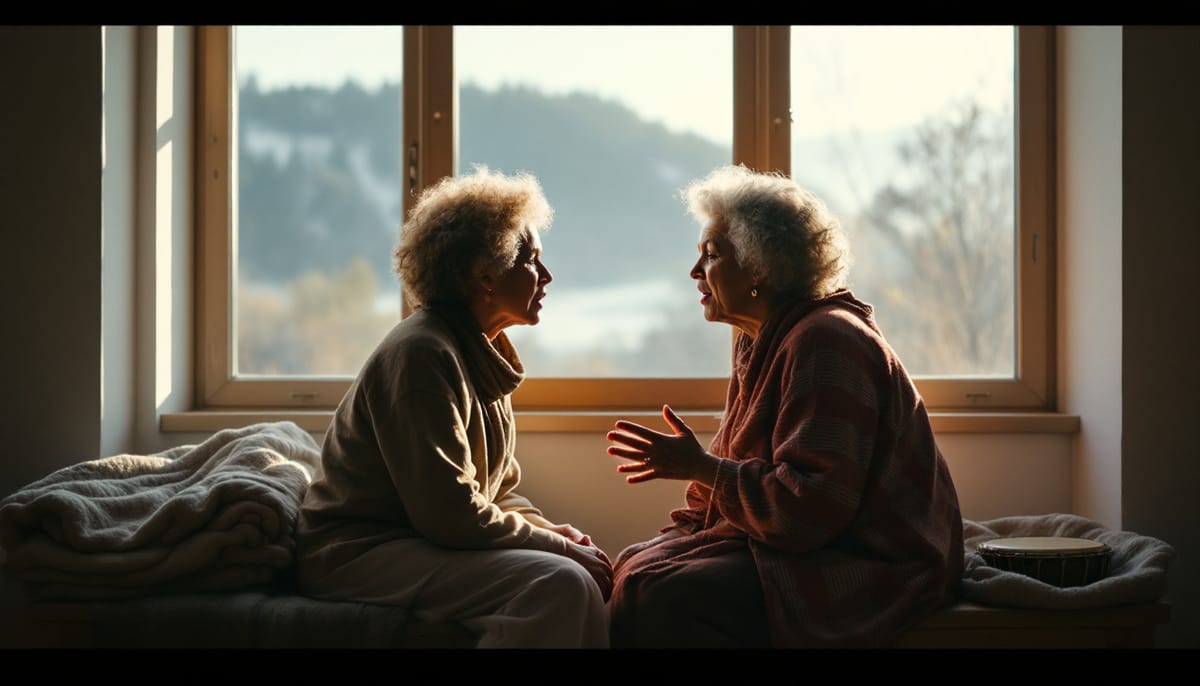
In short — Katajjaq is a traditional Inuit women's vocal game in which two people face each other and exchange rhythmic motifs made of breath, syllables and silences. The sounds evoke wind, ice and animals, making the voice a shared landscape. It cultivates breath, rhythm and listening.
There are sound practices that seek neither performance nor spectacle, but a shared attention. Katajjaq, the traditional vocal game of Inuit women, is one of them. Two people face each other, sometimes holding each other by the shoulders, and exchange rhythmic motifs made of breathed sounds, brief syllables, suspended silences. One proposes, the other answers; breath becomes a common material. For anyone interested in cultural sound relaxation, this vocal game offers a precious example: the voice draws a landscape there—that of wind, ice, animals, daily life.
At Sonocrea, we explore these repertoires with respect and curiosity. Not to turn them into wellness recipes, but to listen to what they teach about attention, rhythm and presence. This article offers a documented stroll through katajjaq, its origins, its gestures, and the lessons in relaxation that can be drawn from it without ever betraying its cultural dimension.
What is katajjaq?
Katajjaq is a vocal game traditionally practiced by Inuit women, notably in the Canadian Arctic, in Greenland and in Alaska. It consists of a duet: the two participants stand face to face, often very close, and produce rhythmic motifs with the throat, the mouth and the breath. The sounds sometimes imitate animal calls, the noises of nature or situations from everyday life. The game continues until one of the two breaks the rhythm, laughs or catches her breath.
It is not a competition in the strict sense: the playful and relational dimension dominates. In the accounts gathered by ethnographers and researchers, katajjaq appears as a moment of closeness, often practiced between friends or members of the same family. Its practice nearly disappeared under the effect of assimilation policies and forced sedentarization; for several decades it has been experiencing a revival carried by artists and communities.
To understand this game, one must forget our habits of melodic singing. Here, the voice works in a zone close to breath, with rapid attacks and low resonances. The ear focuses on the pulse, the regularity, the closeness of the two partners.
A voice that draws a landscape
The expression "when the voice becomes landscape" is not a decorative metaphor. In katajjaq, the sounds evoke the environment: the wind rubbing against the snow, the step of an animal, the lapping of water, the creaking of ice. The voice does not describe the landscape from the outside; it makes it from the inside, through respiratory gestures.
This idea is found in other traditions. In Mongolian throat singing, performers play with harmonics that imitate the steppes, rivers and mountains. In West Africa, certain vocal polyphonies of the Aka Pygmies superimpose brief motifs and yodels that dialogue with the forest. In South India, the vocalises of Carnatic singing draw melodic curves that evoke spaces and seasons. Each time, the voice is an instrument of sensitive geography.
Katajjaq adds a particular dimension: relationship. The landscape is not solitary; it is woven by two. This is perhaps its most immediate lesson for us, who often listen alone, headphones on. Relaxation can also be a matter of dialogue.
The sound gesture: breath, rhythm, listening
Let us describe concretely what happens. The two people stand close, sometimes forehead to forehead. One launches a short motif, repeated; the other answers by aligning her own motif. The sounds are produced by movements of the throat and mouth, with controlled breathing. The rhythm is regular, but can shift slightly, creating a playful tension.
Three qualities to observe
- Breath: the game forces one to breathe differently, through small rapid intakes of air, without losing the pulse.
- Rhythm: regularity is not mechanical; it is alive, like a shared pulse.
- Listening: each partner must anticipate the other, feel the moment when the motif will change.
These three qualities are also those cultivated in a sound relaxation practice: ample breathing, a stable rhythm, an untensed listening. The difference lies in the framework: katajjaq is a situated cultural game, with its rules and its history. One can be inspired by it, never reduce it to a wellness exercise.
Other traditions offer comparable gestures. In the dhrupad of North India, singers work at length on breath and the holding of sound before entering the rhythm. In Andalusian flamenco, the jaleo—the rhythmic interjections that accompany the singing—creates an intense collective listening. In Japanese taiko, the strike is inseparable from a posture and a breath. Everywhere, voice and body learn to slow down in order to hold better.
Listening without appropriating: an ethic of curiosity
Katajjaq is a living heritage. To listen to it, study it, cite it with precision is one thing; to reproduce it without context is another. Inuit communities have suffered decades of cultural dispossession; the least attention consists in naming sources, recognizing artists and not turning a ritual or social game into a relaxation gadget.
This caution applies to all traditions. When one listens to Algerian raï, Portuguese fado, Javanese gamelan or Navajo chant, one hears stories, languages, memories. The cultural sound relaxation that we defend at Sonocrea assumes this responsibility: to offer atmospheres inspired by repertoires of the world, without ever claiming to reproduce a sacred ritual or promising an effect.
Concretely, this means favoring quality recordings, crediting performers, explaining contexts, and leaving everyone free to go further. A sound library is not a museum; it is an invitation to respectful curiosity.
Relaxation as shared attention
What should we take from katajjaq for our sound lives? First, that the voice is a landscape: it can evoke wind, snow, forest, without mystical imagery. Then, that listening is relational: we relax better when we feel accompanied, even by a simple rhythm. Finally, that formal simplicity does not exclude finesse: two repeated motifs are enough to create a mental space.
In a personal practice, one can draw inspiration from this sobriety. Choose a short sound, repeat it, leave a silence, then resume. Alternate moments of active listening and moments of simple presence. Some people prefer a female voice, others a male voice; others still a solo instrument. The essential thing is to find a rhythm that does not accelerate the breathing.
Sound relaxation applications such as Sonocrea offer atmospheres and narratives inspired by these wisdoms of the world, with original scripts written in respect for the sources. There you will find soundscapes, slow spoken voices, discreet textures. Nothing spectacular: an invitation to settle attention, in the manner of two katajjaq partners looking at each other before beginning.
Conclusion: one voice, two presences
Katajjaq recalls an obvious truth that our saturated sound era makes us forget: the voice does not need to be beautiful to be right. It needs to be listened to. Between two people answering each other, the landscape is built in small touches, with breath and rhythm. It is a lesson in sobriety, closeness and patience.
If you wish to explore these sound territories gently, discover the atmospheres and narratives of Sonocrea: experiences of cultural sound relaxation, designed for attentive listening and comfort, without excessive promises. Take the time for a pair of headphones, a soft light, and let the voice draw its landscape.
Precaution: do not listen while driving; in case of epilepsy or psychiatric disorders, seek medical advice.
Frequently asked questions
What is katajjaq?
Katajjaq is a vocal game traditionally practised by Inuit women in the Canadian Arctic, Greenland and Alaska. Two participants stand face to face and exchange rhythmic motifs made with the throat, mouth and breath, often imitating animal calls or natural sounds, until one breaks the rhythm or laughs.
How does katajjaq relate to relaxation?
Katajjaq cultivates three qualities also found in sound relaxation: controlled breath, a stable living rhythm and attentive listening to a partner. It is not a wellness exercise, but its sobriety and shared attention can inspire calm personal listening practices.
Why should katajjaq be approached with cultural respect?
Katajjaq is a living heritage that nearly disappeared under assimilation policies and forced sedentarisation. Inuit communities have suffered cultural dispossession, so listening should involve naming sources, crediting artists and never reducing the game to a relaxation gadget.
Read also
Découvrez Sonocrea
Créez vos propres séances de bien-être sonore avec notre IA. Fréquences binaurales, hypnose audio et sons ambiants personnalisés.
Essayer gratuitement →