Li Qingzhao, Song Poet: The Soothed Melancholy
Li Qingzhao, a Song dynasty poet, turned exile and loss into brief, precise poems of soothed melancholy. Her attention to detail invites us to slow down and listen.
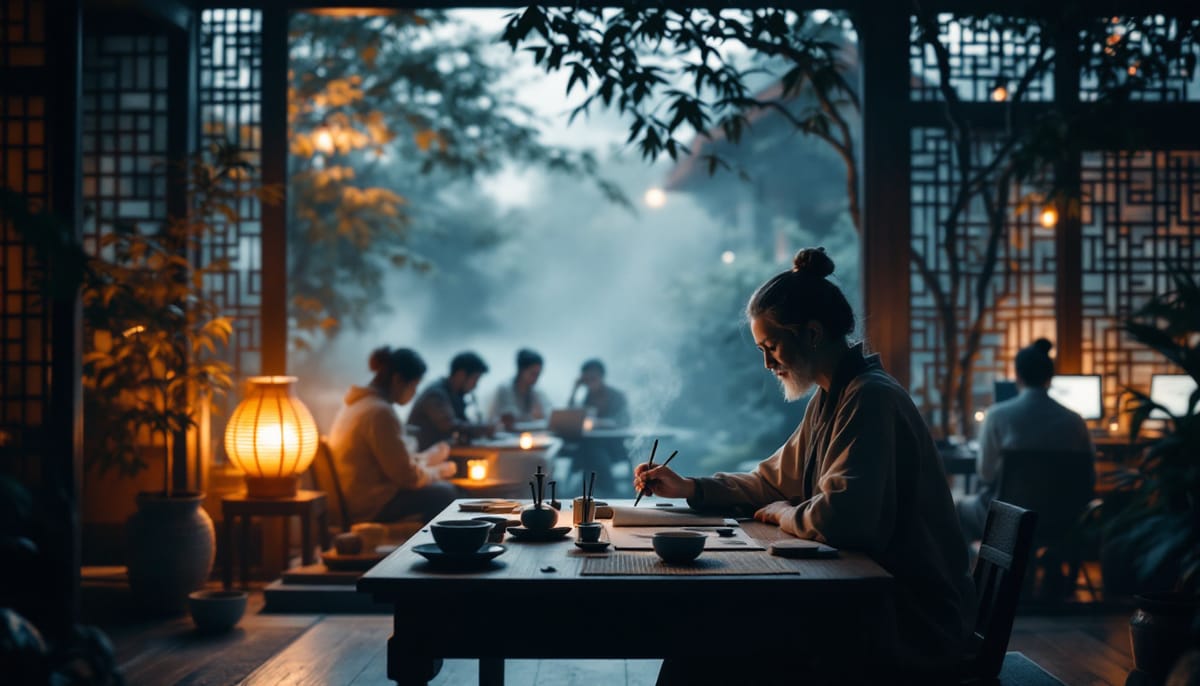
In short — Li Qingzhao was a Song dynasty poet whose brief, precise ci poems express a soothed melancholy, a gentle awareness that everything passes. Her attention to small details, such as a faded flower or a lamp, invites readers to slow down and listen.
There are voices that cross the centuries without losing their gentleness. Li Qingzhao (1084–c. 1155), a poet of the Song dynasty, is one of the most luminous and most discreet of them. Her work, made of soothed melancholy, invites us to slow down, to listen to the world, and to welcome what passes. In this article, we explore her life, her images, and the way her poetry can nourish a cultural sound relaxation — a form of unwinding that draws on literature, music, and philosophy rather than on miracle recipes.
A life between splendor and exile
Li Qingzhao was born into a lettered family in Shandong. Her father, a scholar, encouraged her to read and write; her mother, also cultivated, passed on to her a taste for the classics. Rare for the time, she received a solid education and very early developed a personal style, at once delicate and precise.
She married Zhao Mingcheng, a scholar passionate about epigraphy. The couple shared books, engraved stones, walks, and learned conversations. Then came turmoil: invasions, displacements, separations, the death of her husband in 1129. Li Qingzhao spent the second part of her life in exile, between southern China, lawsuits, material losses, and solitude. Her poetry nonetheless retains a remarkable restraint: she does not collapse, she observes.
This trajectory recalls other voices of lettered women around the world: in India, the poet and princess Muddupalani composed a learned and sensitive work in the eighteenth century; in the Persian world, Mahsati Ganjavi, a poet of the twelfth century, handled the quatrain with ironic elegance. Comparing these paths is not to confuse them: it is to recognize the same demand for finesse, in different contexts.
The art of detail: what Li Qingzhao teaches us about attention
Li Qingzhao excelled in the ci, that sung poetic form, linked to musical tunes. Her poems are brief, often built around an object: a faded flower, a curtain, a lamp, a boat, a fading perfume. The outer world becomes an inner mirror, without ever forcing the point.
This attention to detail is a lesson in presence. It joins what other traditions cultivate in their own way:
- In China, literati painting and poetry invite us to contemplate a landscape rather than to dominate it.
- In Japan, the haiku of Matsuo Bashō (seventeenth century) and the poetic journals of court women, such as those of Sei Shōnagon, fix the moment in a few words.
- In the Arab world, the Andalusian poet Wallada bint al-Mustakfi (eleventh century) plays with concision and boldness; the poet Al-Mutanabbi, a century earlier, cultivated the power of the image.
- In West Africa, griots and griottes transmit stories in which rhythm carries memory; the spoken word is already music.
In an approach to unwinding, these examples are not models to be slavishly imitated: they are invitations to listen differently, to let a line resonate without seeking to understand everything.
Soothed melancholy: a nuance to cultivate
The word "melancholy" can be worrying. In Li Qingzhao's work, it designates less a suffering than a tonality: the awareness that everything passes, that the seasons turn, that beings change. This lucidity is not a trap; it can become a form of gentleness.
Several philosophical traditions have explored this nuance:
- Greco-Roman Stoicism, with Seneca and Epictetus, invites us to distinguish what depends on us from what does not.
- Taoism, with Laozi and Zhuangzi, proposes to follow the course of things without opposing it.
- The Indian philosophy of samkhya and the reflections of the thinker and poet Mirabai (sixteenth century) show how fervor can coexist with the awareness of fragility.
In a cultural sound relaxation session, it is not a matter of "curing" a sadness or making it disappear. It is a matter of offering a space where an emotion can be named, listened to, and gradually set down. A reader in Nantes can listen to a poem by Li Qingzhao as a reader in Dakar listens to a griot's tale: not to flee the world, but to return to it more available.
Listening to poetry: another way to unwind
Li Qingzhao's poetry was sung. Its musicality is not an ornament: it carries the meaning. In a practice of sound relaxation, one can draw on this idea without distorting it:
Choose a short text and a steady voice
A quatrain, a fragment of ci, a few lines of prose are enough. What matters is slowness, the silence between sentences, the breathing that settles in.
Create a sober soundscape
A sustained note, a breath, a light rubbing: the original scripts of Sonocrea draw inspiration from the world's wisdom traditions and from literature, without ever reproducing a sacred ritual or promising a particular effect. Each session is a proposition, not a prescription.
Alternate the references
One can move from a poem by Li Qingzhao to an excerpt by the Ethiopian poet Senedu Gebru, or to a text by the Persian thinker Omar Khayyam, then return to silence. This alternation avoids monotony and opens listening to several cultural areas, presented with respect and precision.
Set up a simple ritual
An armchair, a soft light, ten minutes. No performance, no goal. Unwinding is not a result to be achieved; it is an availability that one cultivates.
Silence as a space of freedom
Li Qingzhao often writes from a room, behind a curtain, near a lamp. This intimate setting reminds us that unwinding does not require vast spaces. A shared office, a kitchen, a train: everywhere, one can find a little calm if one agrees to slow down.
The world's traditions offer varied resources here. In Southeast Asia, the sung tales of storytellers in Bali or Java establish a collective listening. In the Americas, the stories of Indigenous peoples, carefully transmitted by their holders, recall the link between speech, place, and memory. In Europe, the poetry of the troubadours and trobairitz of the Middle Ages, such as that of the poet Beatritz de Dia, already plays with voice and echo.
None of this is a remedy. These are companions in listening, ways of inhabiting time. Li Qingzhao's soothed melancholy is not a lesson to be applied; it is a tonality to be frequented.
Conclusion: an invitation to slow down
Li Qingzhao leaves us brief, precise poems, in which sadness is never spectacular. She reminds us that an emotion can be welcomed without being dramatized, and that the beauty of a detail — a flower, a perfume, a light — is sometimes enough to reopen the inner space.
To extend this reading, you can explore the cultural sound relaxation sessions of Sonocrea: original scripts inspired by literature, music, and philosophy from around the world, to listen to quietly, at home. Take the time to choose a calm moment, settle in comfortably, and let the voice make its way.
Precaution: do not listen while driving; in case of epilepsy or psychiatric disorders, ask a doctor's advice.
Frequently asked questions
Who was Li Qingzhao?
Li Qingzhao (1084–c. 1155) was a poet of the Song dynasty, born into a lettered family in Shandong. She married the scholar Zhao Mingcheng and spent her later life in exile, writing brief, precise ci poems marked by restraint.
What does soothed melancholy mean in her poetry?
In Li Qingzhao's work, melancholy is less a suffering than a tonality: the awareness that everything passes, that seasons turn and beings change. This lucidity can become a form of gentleness rather than a trap.
How can her poetry support sound relaxation?
Her poems were sung, and their musicality carries meaning. A cultural sound relaxation can draw on this by choosing a short text, a steady voice, a sober soundscape and silence between sentences, without promising any particular effect.
Read also
Découvrez Sonocrea
Créez vos propres séances de bien-être sonore avec notre IA. Fréquences binaurales, hypnose audio et sons ambiants personnalisés.
Essayer gratuitement →