The Japanese Tea Ceremony: Listening to Water, Fire, and Silence
The Japanese tea ceremony is a school of listening: water shivering before the boil, fire setting the tempo, and a silence that is a presence rather than an absence.
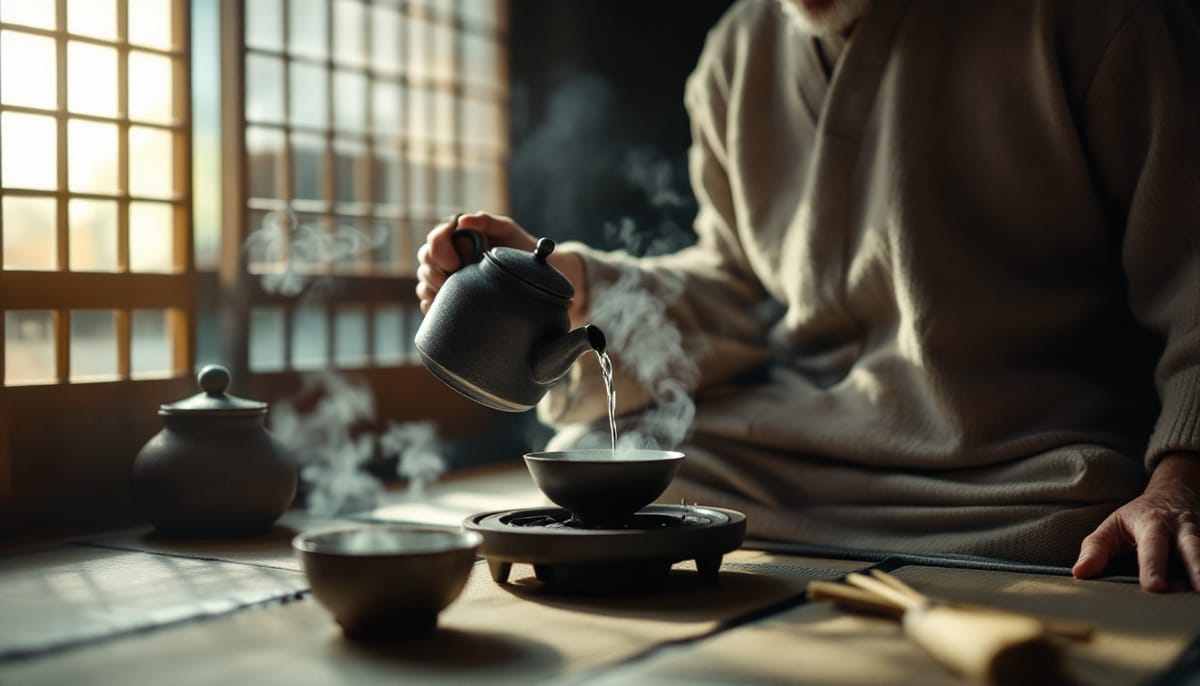
In short — The Japanese tea ceremony, or chanoyu, trains the ear to notice water shivering before the boil, the slow rhythm of the charcoal fire and a silence made of breaths and small sounds. Its lesson can be carried into ordinary days through brief, attentive listening.
There are places where the noise of the world comes to an abrupt halt. A tatami room, a ceramic bowl, a cast-iron kettle set on a charcoal hearth. The Japanese tea ceremony, or chanoyu, is not merely a ritual of preparation: it is a school of listening. There one learns to hear the water as it shivers, the fire as it breathes, and that particular silence which is not an absence but a presence. For Sonocrea, an app for cultural sound relaxation, this practice is an invitation to slow the ear.
An Aesthetic of Attention Born in Japan
The way of tea took shape over the centuries around figures such as Sen no Rikyū, a sixteenth-century master who gave the ceremony its sobriety and its spareness. But history also counts women: one thinks of the tenth-century Japanese poet and calligrapher whose court narratives already describe the attention paid to the sounds of the house, to footsteps on wood, to poured water. Chanoyu rests on four principles often translated as harmony, respect, purity, and tranquility. Nothing mystical here: a concrete discipline of gesture and ear.
This attention to the sonic runs through other traditions. In the Persian world, Rûmî's poetry often compares listening to a door that opens; in India, classical musical treatises describe the raag as an architecture of time, in which the silence between two notes is part of the phrase. In Japan, tea proceeds from the same idea: what matters is not volume, but the rightness of the moment.
Listening to Water: The Shiver Before the Boil
In a traditional ceremony, water is never brought to a rolling boil. The tea master listens for successive sounds, often compared to wind in the pines, then to fine rain. It is these nuances that one listens to, more than the din of boiling. A lesson in sound relaxation: calm is rarely found in total silence, but in a gentle sound to which one agrees to make oneself available.
The nineteenth-century British writer and traveler, in her accounts of stays in Asia, already noted how the sound of poured water could structure a conversation. Conversely, a West African storyteller, in the griot tradition, uses the rhythm of his sentences as one pours water: in waves, with pauses that let the audience breathe. Both gestures, that of tea and that of storytelling, rest on the same grammar of the interval.
- First listen to the background sound of the room, without changing anything.
- Notice a sound of water, real or recorded, and follow it for a few minutes.
- Let the other sounds exist, without chasing them away.
Listening to Fire: The Warmth That Sets the Tempo
The charcoal hearth, in a tea room, imposes a slow rhythm. One does not hasten the fire; one attunes oneself to it. This patience recalls evenings gathered around the hearth among many peoples: in the narratives of the Indigenous peoples of North America, speech is often given near the fire, and one waits for the wood to crack before speaking again. In Europe, winter evening tales worked in the same way, with the flame as metronome.
For a practice of relaxation, it is not a matter of reproducing a sacred ritual, but of retaining its lesson in listening. A person preparing tea in the morning can, in a few seconds, pay attention to the sound of the gas, of the kettle, to the clink of the cup. It is a simple, accessible sound anchor that requires no special equipment.
Silence: A Material to Listen To, Not a Void to Fill
The silence of the tea ceremony is not an absolute silence. It is made of breaths, of fabrics that brush, of ceramic set on tatami. Japanese philosophers of the Kyoto School, such as Nishida Kitarō, thought at length about this idea of a fertile emptiness, of a space that welcomes. One finds a comparable intuition in the medieval European philosopher and mystic Hildegard of Bingen, who described creation as a continuous word, and in the Andalusian Arab poet Wallada, whose short verses leave as much room for silence as for words.
In the practice of cultural sound relaxation, this silence is tamed. One can listen to a recording of rain, of footsteps on gravel, of pages turned, then gradually remove one sound to let the ear rest. Sonocrea offers sessions inspired by these wisdoms of the world: original scripts, written in a spirit of listening, never rituals reproduced identically.
Transposing the Spirit of Tea into an Ordinary Day
No tea house is needed to cultivate this attention. A woman working in an office can, before opening her messages, listen to the sound of her cup set on the table. A man coming home from work can sit for two minutes and listen to the rain on the window. The tea ceremony teaches the punctuality of listening: a brief moment, fully inhabited.
One can also draw inspiration from nō theater, where the silence between two lines carries the meaning, or from the tales of the islands of Southeast Asia, where the performer modulates his voice as one modulates the heat of the water. Every tradition has its nuances; to name them with respect is already a form of listening.
- Choose an everyday sound object: kettle, spoon, lid.
- Listen to it for thirty seconds, without judging.
- Mentally note what has changed in your breathing.
Conclusion: One Cup, Three Sounds, One Moment
The Japanese tea ceremony reminds us that sound well-being is not manufactured with a great array of effects: it is cultivated in attention. Water, fire, and silence form a simple score, available everywhere, provided one agrees to slow down. To extend this listening, discover the cultural sound relaxation sessions of Sonocrea at https://sonocrea.com: stories and atmospheres inspired by the literatures and philosophies of the world, to be savored like a bowl of tea.
Caution: do not listen while driving; in case of epilepsy or psychiatric disorders, seek medical advice.
Frequently asked questions
What sounds does one listen to during the Japanese tea ceremony?
The tea master listens to water before it reaches a rolling boil, hearing sounds compared to wind in the pines and then fine rain. The charcoal fire sets a slow rhythm, and the silence is filled with breaths, brushing fabrics and ceramic set on tatami.
How can I bring the spirit of chanoyu into an ordinary day?
Choose an everyday sound object such as a kettle, spoon or lid, and listen to it for thirty seconds without judging. You can also pause before opening your messages to hear your cup set on the table, or listen to rain on the window.
Is the silence of the tea ceremony a total silence?
No. The article explains that this silence is not an absence but a presence, made of breaths, fabrics that brush and ceramic set on tatami. It is a fertile emptiness that welcomes, rather than a void to fill.
Read also
Découvrez Sonocrea
Créez vos propres séances de bien-être sonore avec notre IA. Fréquences binaurales, hypnose audio et sons ambiants personnalisés.
Essayer gratuitement →