West African Griots: Storytelling and Calm
The griots of West Africa keep memory alive through voice, kora and genealogy. Their storytelling offers a framework of calm and slow, attentive listening.
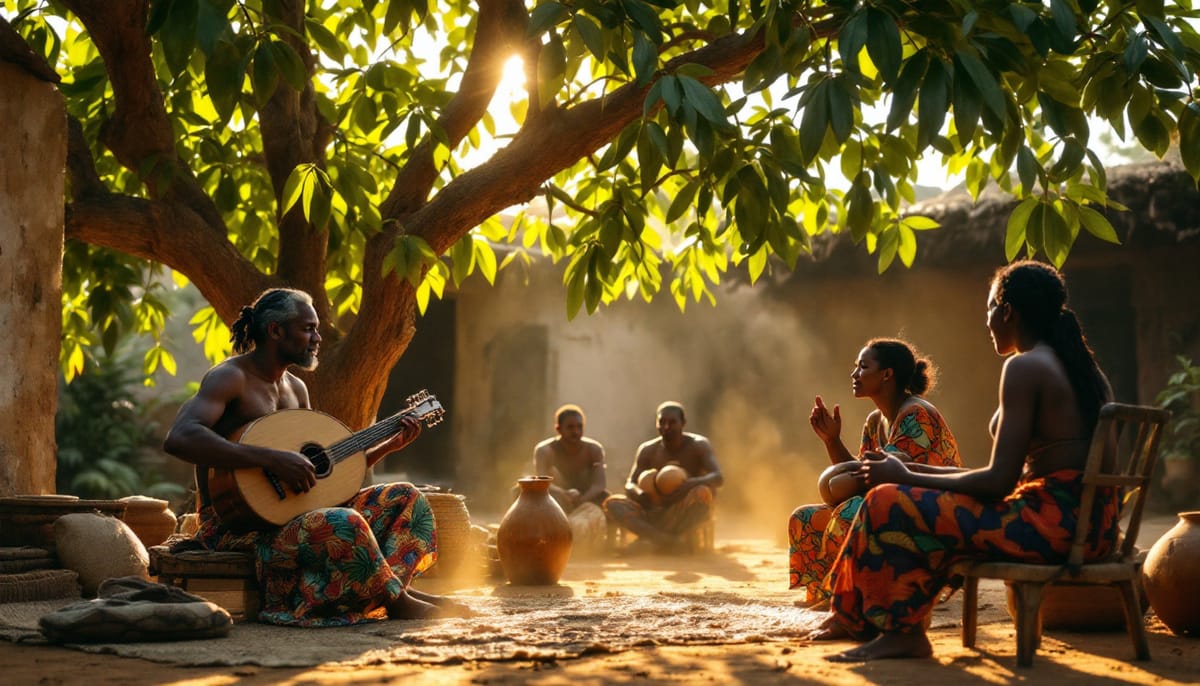
In short — Griots, or jeli, are West African keepers of memory who tell genealogies and stories with voice and instruments such as the kora. Their repetitive, unhurried narratives create a framework of attention that settles the mind, offering a cultural doorway into calm listening.
A voice that soothes: entering the world of the griots
In the savannas and cities of West Africa, there is a figure whose voice alone is enough to slow time: the griot, or jeli in the Mandingue language. Neither a simple storyteller nor a simple musician, he is the keeper of a long memory—that of families, villages and kingdoms. His art rests on the spoken word, storytelling and genealogy, and it produces a singular effect: that of a moment of calm, of an attention that settles.
At Sonocrea, we believe that certain traditions of the world offer doorways into relaxation without promising anything other than the comfort of a moment. The griots' spoken word is one of them. Not because it would involve some mysterious power, but because it establishes a way of listening, a slowness, a presence. It is this quality of attention that we explore here.
Who are the griots? A living memory, passed down from generation to generation
The term "griot" comes from French, but Mandingue societies speak of jeli, the Fulani of gawlo, the Wolof of gewel. These artists of the spoken word hold a recognized place in the social organization: they accompany births, weddings, funerals and reconciliation celebrations. They know the names, alliances and stories of each person, and know how to tell them at the right moment.
Their emblematic instrument, the kora, is a calabash harp-lute whose 21 strings are plucked with the thumbs. One also encounters the ngoni, the balafon or the hoddu, depending on the region. But the essential remains the voice: a voice that modulates, repeats, amplifies, and that, through its very continuity, creates a space of rest.
Among the great female voices of this tradition, one can mention Sona Jobarteh, a Gambian kora player and singer who opened to women an instrument long reserved for the men of her family. On the male side, Toumani Diabaté, a Malian kora virtuoso, brought this music into dialogue with other horizons. These artists do not "heal" anyone: they tell stories, they play, and the listening does its work.
Storytelling as a space of calm: why the spoken word slows things down
To listen to a long, genealogical, repetitive story is to accept not understanding everything right away. The griot's narrative does not seek narrative efficiency: it unfolds, it returns, it names. This circular structure resembles what other cultures call the evening gathering, the tale by the fireside, the shared recitation.
This soothing relationship with the spoken word is found in several cultural areas. In the Arab and Persian world, the hakawati, a storyteller of public squares, creates a pause in the day by unfolding episodic tales. In India, the kathakars of Rajasthan tell epics in song, and the audience follows the thread for hours. In East Asia, the practice of tea and slow conversation, in Japan as in China, makes the spoken word a moment of pause rather than an exchange of information.
What links these traditions is not a belief, it is a shared attention. The narrative creates a framework: one knows when it begins, one accepts that it lasts, and the mind settles. This is exactly what a cultural sound relaxation practice seeks: a clear framework, a voice, a rhythm.
Three concrete elements that promote listening comfort
- Repetition: greeting formulas and refrains return, which avoids the effort of memorization.
- Timbre: the griot's voice is often deep and steady, accompanied by a continuous instrument such as the kora.
- Accepted duration: a long narrative is not a flaw, it is an invitation to slow down.
Women and men of the word: a parity to restore
The collective imagination long presented the griot as a man. The reality is more nuanced: the jeli muso, women of the griot caste, sing, praise, advise and pass on as well. Their role has sometimes been downplayed in written accounts, often by outside observers.
This question of the female voice runs through other traditions. In Japan, the goze, itinerant blind musicians, carried story and song from village to village. In the Persian world, the poet Forough Farrokhzad reinvented the diction of intimate speech. In West Africa, Sona Jobarteh and the Malian singer Fatoumata Diawara extend this lineage, while Toumani Diabaté and Bassekou Kouyaté embody its male branch. To listen to both is to hear a complete memory.
In our scenarios, we deliberately alternate the figures: a librarian listening to a story on her way home, a nurse granting himself ten minutes of kora before sleeping, a student noting a phrase heard in a tale. None of these people expects a spectacular result: they are seeking a moment of comfort.
How to integrate the spirit of the griot into a sound relaxation practice
It is not about reproducing a ritual, still less about appropriating a sacred word. It is about drawing inspiration from a posture of listening: accepting the narrative, following the voice, letting the images come without forcing them.
Concretely, one can:
- Choose a recording of kora or of a storytelling voice, and listen to it without doing anything else, seated or lying down comfortably.
- Read aloud a short passage from a tale, favoring rhythm over interpretation.
- Keep a notebook in which to note a phrase, an image, a name heard, as one remembers the genealogy of a narrative.
- Alternate stories from different horizons: a Mandingue tale, a story from the One Thousand and One Nights, an episode of the Ramayana, a Native American narrative, a European tale.
The original audio scripts offered in Sonocrea, a sound relaxation app, follow this approach: texts inspired by the wisdom of the world, written to be listened to slowly, without word-for-word quotation of existing translations, and without any promise of results. There you will find voices, silences, soundscapes, and this simple idea that the spoken word can be a place of rest.
A listening that asks for nothing
The power of narrative, among the griots as elsewhere, perhaps lies in this: it does not ask you to answer. You can close your eyes, lose the thread, come back. This freedom is in itself a comfort. In a daily life saturated with solicitations, a voice that unfolds a story without urgency constitutes an accessible, free and deeply cultural pause.
Conclusion: the spoken word as a resting place
The griots of West Africa remind us that a voice can serve as a refuge, not through magic, but through the quality of attention it establishes. Between the kora of Sona Jobarteh, the tales of the hakawati of the Arab world and the storytelling evenings of so many cultures, one same obvious truth: to tell is to offer time.
To extend this discovery, explore the atmospheres and stories of Sonocrea: cultural sound relaxation sessions designed for quiet listening, at home, without any particular expectation.
Caution: do not listen while driving; in case of epilepsy or psychiatric disorders, seek a doctor's advice.
Frequently asked questions
Who are the griots of West Africa?
Griots, called jeli in Mandingue, are artists of the spoken word who keep the memory of families, villages and kingdoms. They accompany births, weddings, funerals and reconciliation celebrations, telling names, alliances and stories at the right moment.
What instruments do griots play?
The emblematic instrument is the kora, a calabash harp-lute with 21 strings plucked with the thumbs. Depending on the region, one also encounters the ngoni, the balafon and the hoddu, though the voice remains essential.
How can griot storytelling support relaxation?
Its repetition, steady timbre and accepted duration create a clear framework of listening. Following a long narrative without urgency lets the mind settle, which is the spirit of a cultural sound relaxation practice rather than any promised result.
Read also
Découvrez Sonocrea
Créez vos propres séances de bien-être sonore avec notre IA. Fréquences binaurales, hypnose audio et sons ambiants personnalisés.
Essayer gratuitement →