Proust and the Memory of the Senses: Sounds, Smells and Memories
Proust showed how a taste or sound can reopen the past. This article explores how sounds and smells carry memory, across cultures, and how to compose calming atmospheres.
In short — Sounds and smells recall the past quickly because a sensation is tied to a place, a presence and an atmosphere. Proust's madeleine shows how a taste reopens a whole world. Layering gentle soundscapes with a discreet scent can create calm moments where memory settles naturally.
Sometimes all it takes is the clink of a spoon against a cup, a waft of warm wax, or the first notes of a song heard in a childhood kitchen. The memory arrives before we have even tried to remember. This is what Marcel Proust described with a goldsmith's precision in In Search of Lost Time: an ordinary sensation, a taste, a smell, and suddenly a whole world we thought was lost comes rising back.
At Sonocrea, we love this idea: the memory of the senses is not a literary curiosity, it is a daily experience, gentle and accessible. This article explores how sounds and smells weave our memories, blending literature, music and traditions from around the world — and how to use them, simply, to create moments of relaxation and comfort.
The madeleine is not a recipe, it is a door
In the famous madeleine episode, Proust does not merely describe a taste: he describes a chain reaction. The taste of the cake dipped in tea first summons a vague emotion, then the image of Aunt Léonie's house, then all of Combray. The sensation acts like a key: it does not recount the past, it reopens it.
Women writers have explored this mechanism with just as much finesse. The Franco-Lebanese author Amin Maalouf, in his stories, often makes the scent of the homeland a character in its own right; the Moroccan poet and novelist Fatima Mernissi recounts, in her childhood memories, the sounds of the patio, the voices of the women, the lapping of the fountain — a memory that passes through the ear as much as through the memory of words. And the Japanese poet Yosano Akiko, in the early twentieth century, makes the sound of water, the rustle of fabrics, the rain on the roof resonate in her tankas: so many sensations that carry an entire moment.
Let us keep the essential: a sensation is never isolated. It is linked to a place, to a presence, to an atmosphere. That is why a well-designed sound relaxation does not settle for being "pleasant": it establishes a context, a mental setting where memory can settle effortlessly.
Why sound and smell summon the past so quickly
It is often said that smell is the most "memory" sense: a smell of warm bread, of Marseille soap or of wet wood can bring back an entire scene in a second. Sound has a neighbouring quality, but a different one: it is rhythmic and spatial. Footsteps in a corridor, a voice calling in the distance, a hummed refrain: sound restores a place and a time to us, not just an image.
This difference is precious for relaxation. A smell surprises; a sound envelops. We can close our eyes and let a soundscape draw a familiar space: rain on a tin roof, wind in the leaves, the murmur of a distant conversation. This is exactly what a sound relaxation app offers: not to erase reality, but to give it a gentler setting.
- Sound sets the tempo: a slow atmosphere invites us to slow our breathing without having to think about it.
- Smell gives the colour: it anchors the imagination in a precise place.
- Memory makes the connection: it turns an atmosphere into a personal story.
In a simple scenario: Léa, who works in a shared office, slips on her headphones and plays a late-summer-afternoon atmosphere; within minutes, the tension of the day eases. Karim, for his part, prefers the sounds of water and stone, which remind him of the courtyard of the family home. Neither of them is "looking for" a memory: it comes, or it does not, and that is perfectly fine.
Other cultures, other sensory memories
The memory of the senses is not a European affair. Oral traditions around the world make daily use of it, often with great delicacy.
West Africa: the word that remembers
Among the Mandinka griots, memory is passed on through the voice and through an instrument — the kora, the balafon. The tale is not recited: it is played, with inflections, repetitions, silences. To listen to a griot is to understand that memory has a sonic texture. We can draw inspiration from it without imitating anything: a steady voice, a regular rhythm, pauses.
The Arab and Persian world: scent as narrative
In Persian poetry, the scent of the rose and the song of the nightingale return as motifs of nostalgia; among classical Arab poets, the evocation of the abandoned camp often begins with a sensory detail — a breath of wind, a trace of incense. The Andalusian poet Wallada bint al-Mustakfi, for her part, plays with closeness and distance in her verses, the way one plays with an echo.
East Asia: listening to almost nothing
The Japanese tradition of mono no aware — sensitivity to impermanence — places great value on faint sounds: dripping water, wind in the pines, the song of an insect in autumn. The poet Izumi Shikibu turns this into an art of detail. This listening to almost nothing is an excellent school of relaxation: it teaches us not to fill the silence.
The Americas and Indigenous peoples: place as memory
Many Indigenous peoples of North America pass on a memory tied to territory: a song, a place name, a story told in a low voice by a river. These traditions are living and must be approached with respect, without reducing them to a backdrop. We can take from them a simple, universal idea: a sound can name a place, and remembering a place soothes.
Composing an atmosphere that speaks to your memories
No need for complicated equipment. It is more a matter of a small listening ritual, to be adapted to the moment.
- Choose an anchor: a place (the sea, a forest, a kitchen), a season, an hour of the day.
- Layer two levels: a continuous background (rain, wind, murmur) and a discreet detail (a drop, a rustle, a sustained note).
- Leave silences: they allow memory to breathe.
- Do not force it: if no image comes, the atmosphere simply remains comfortable, and that is already a great deal.
Some prefer a voice that gently guides, others instrumental music. At Sonocrea, the original scripts draw on the wisdom of the world — a tale, an image from nature, a philosophical reflection — without ever reproducing an existing text word for word or promising any particular effect. Each session is a proposition, not a prescription.
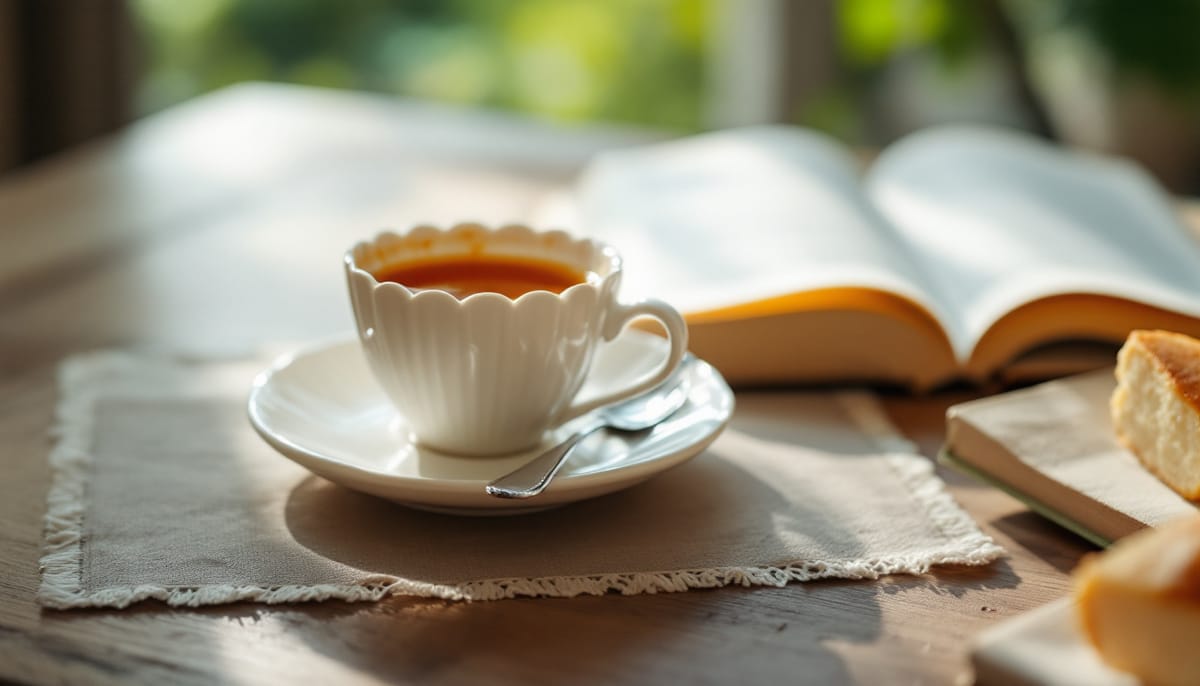
You can also pair a discreet scent with the listening: a cup of tea, a citrus peel on the table. The link between sound and smell then weaves itself naturally, effortlessly, as with Proust — but without the obligatory madeleine.
A philosophy of presence, not performance
Proust's lesson is not "seek out your memories". It is rather: accept being surprised. The true memory arrives by accident, when we are not lying in wait for it. The philosopher Simone Weil wrote that attention is a form of availability; the Chinese thinker Zhuangzi, for his part, invited us to listen to the wind in the trees as a lesson in things. Two very different ways of saying the same thing: make yourself available, without tension.
This is the spirit of a cultural sound relaxation: to offer an elegant, literary, musical setting where one can settle. No performance, no goal. Just an atmosphere, a voice perhaps, and the time to let things come.
Conclusion: offering a door to your memories
Sounds and smells are discreet doors. Proust made them into a work of art; poets around the world have made them into songs, tankas, stories. Each of us has our own, often without knowing it. A well-chosen soundscape can simply open them a little.
To extend this reading, discover the cultural sound relaxation sessions of Sonocrea: atmospheres inspired by literature, music and philosophy, to listen to at home, at your own pace. Settle in comfortably, choose a sound that speaks to you, and let the rest come.
Precaution: do not listen while driving; in case of epilepsy or psychiatric disorders, ask a doctor's advice.
Frequently asked questions
Why do sounds and smells bring back memories so quickly?
According to the article, a sensation is never isolated: it is linked to a place, a presence and an atmosphere. Smell can restore a whole scene in a second, while sound is rhythmic and spatial, restoring a place and a time rather than just an image.
What does the madeleine episode in Proust actually show?
Proust describes a chain reaction rather than a simple taste. The cake dipped in tea first summons a vague emotion, then the image of Aunt Léonie's house, then all of Combray. The sensation acts like a key that reopens the past.
How can I compose a sound atmosphere for relaxation?
Choose an anchor such as a place, season or hour, then layer a continuous background with a discreet detail. Leave silences so memory can breathe, and do not force images: if none come, the atmosphere simply remains comfortable.
Read also
Découvrez Sonocrea
Créez vos propres séances de bien-être sonore avec notre IA. Fréquences binaurales, hypnose audio et sons ambiants personnalisés.
Essayer gratuitement →