Sound Meditation: A Complete Beginner's Guide
Sound meditation, or sound bath, uses sounds and vibrations as an auditory anchor to support deep relaxation. This guide covers its origins, instruments, benefits and how to begin.
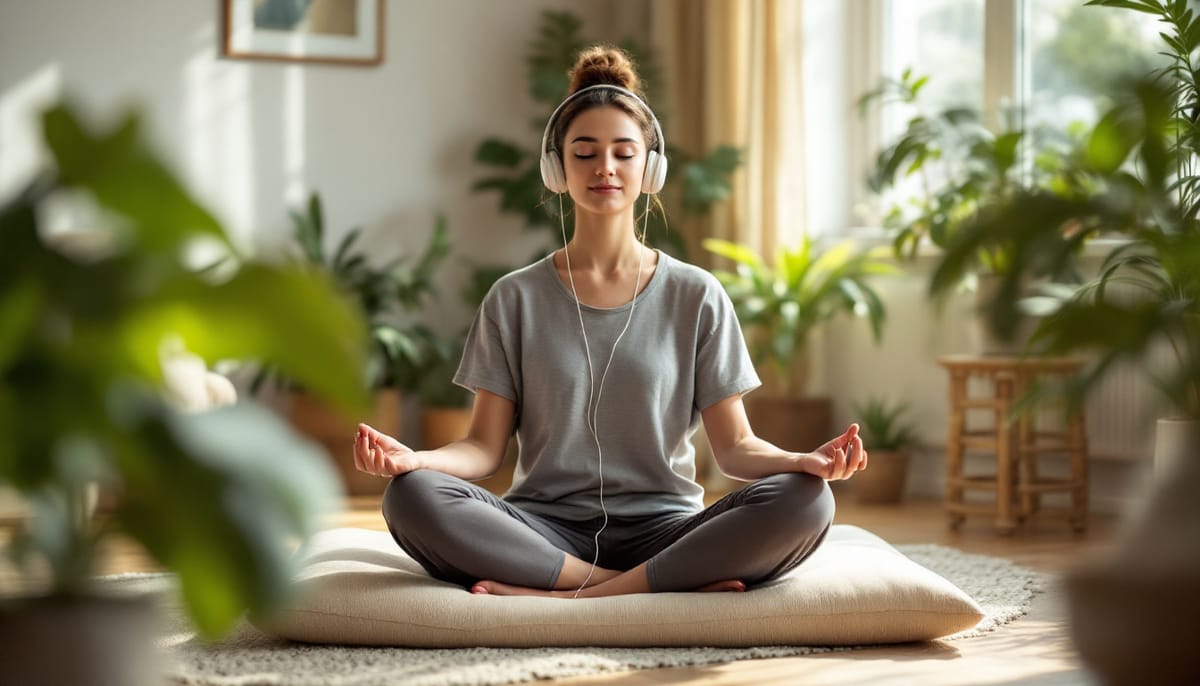
In short — Sound meditation, also called a sound bath, is a form of meditation guided by sounds and vibrations. It offers an auditory anchor that makes it easier for beginners to settle into relaxation. Sessions usually involve lying down and listening attentively to instruments or natural sounds.
In our hyperconnected world where silence is rare, more and more people are turning to sound meditation to find calm and serenity. This ancestral practice, brought back into fashion, uses the power of sound to facilitate deep relaxation and grounding in the present moment. Whether you are new to meditation or simply curious to explore new approaches to well-being, this complete guide will accompany you in your first steps toward this unique sensory experience.
What exactly is sound meditation?
Sound meditation, also called a sound bath, is a form of meditation guided by sounds and vibrations. Unlike traditional silent meditation, which can seem difficult for beginners, it offers an auditory anchor that greatly facilitates entering a state of relaxation.
The origins of an ancient practice
The use of sound for well-being dates back thousands of years. Tibetan singing bowls have been used for more than 2,000 years in Buddhist traditions. Gongs have accompanied Asian ceremonies since antiquity. Sacred chants are an integral part of many cultures, from Indian mantras to Western Gregorian chants.
Today, this ancestral wisdom meets our modern understanding of relaxation to create sound experiences accessible to everyone.
How does sound meditation work?
The principle is simple: you settle in comfortably, usually lying down, and let the sounds envelop you. Your only task is to listen attentively and let the vibrations act on your body and mind.
The sounds used often have particular characteristics:
- Specific frequencies that promote relaxation
- Slow rhythms that naturally invite slowing down
- Rich sound textures that capture attention without tiring it
- Natural harmonics that create a feeling of envelopment
The different types of sounds used in sound meditation
The richness of sound meditation lies in the diversity of instruments and sounds that can be used. Each type has its own characteristics and may suit different sensitivities.
Traditional instruments
Tibetan bowls remain the emblematic instruments of sound meditation. Made from metal alloys, they produce sounds rich in harmonics when struck or made to sing with a mallet. Their vibration is often described as enveloping and deeply soothing.
Gongs offer a powerful and immersive sound experience. Their intense vibrations create a veritable sound wave that can be felt physically throughout the body.
Chimes and koshis produce crystalline and delicate sounds, perfect for moments of lightness and elevation. They are often used to mark the beginning or end of a session.
Sounds of nature
Natural sounds are an excellent gateway for beginners:
- Flowing water: streams, gentle rain, waves
- Forest: birdsong, rustling leaves, wind in the trees
- Nighttime ambiences: crickets, owls, quiet night
These familiar sounds have the advantage of being immediately recognizable and reassuring to our brain.
Frequencies and synthetic sounds
Modern technology makes it possible to create soundscapes specially designed for relaxation. Applications like Sonocrea offer elaborate sound environments that combine different sources for an immersive and customizable experience.
Observed benefits of sound meditation
Many practitioners report positive effects after their sound meditation sessions. Although each experience is personal and unique, certain benefits come up regularly in testimonials.
In terms of relaxation
The first effect usually noticed is a feeling of deep calm. Sounds act like a protective cocoon that allows you to temporarily disconnect from daily worries. Many people describe a progressive muscular release, particularly in the shoulders, jaw, and forehead, areas where we often accumulate tension.
On sleep quality
Practicing sound meditation at the end of the day can help create a gentle transition to sleep. Soothing sounds signal to the body and mind that it is time to slow down, thereby making it easier for many people to fall asleep.
On concentration and presence
Paradoxically, this relaxation practice can also improve concentration ability. By learning to focus attention on sounds, one develops a skill that can then be transferred to other areas of daily life.
On emotional management
Sound meditation offers a space to welcome your emotions without judgment. Sound vibrations can sometimes facilitate the release of accumulated emotional tension, offering a feeling of lightness after the session.
How to get started: a step-by-step practical guide
Are you ready to begin? Here is a practical guide to experiencing your first sound meditation session under the best conditions.
Prepare your space
Create an environment conducive to relaxation:
- Choose a quiet place where you will not be disturbed for 15 to 30 minutes
- Dim the lights or close the curtains to create a soft atmosphere
- Adjust the temperature so you are comfortable without being cold
- Prepare support: yoga mat, blanket, cushions
- Turn off notifications on your electronic devices
Choose your audio equipment
The quality of listening directly influences your experience. If possible, use comfortable headphones for optimal immersion. Otherwise, good-quality speakers placed on each side of you will create a pleasant enveloping effect.
Recommended positions
The most common position is lying on your back, arms slightly away from the body, palms facing upward. If this position is uncomfortable for you, feel free to place a cushion under your knees to relieve your lower back, or practice in a comfortable seated position.
Your first session step by step
- Settle in comfortably and close your eyes
- Take three deep breaths to begin relaxing
- Start your sound sequence and let yourself be carried
- Focus on the sounds: their textures, variations, and vibrations
- If your mind wanders, gently bring your attention back to the sounds, without judging yourself
- At the end, take a few moments before opening your eyes and getting up slowly
Recommended frequency and duration
For beginners, start with 10- to 15-minute sessions, 2 to 3 times a week. Gradually, you can extend the duration to 30 or 45 minutes if you wish. Regularity is more important than duration: better to do 10 minutes daily than one long occasional session.
Tips to deepen your practice
Once you have mastered the basics, here is how to enrich your sound meditation experience.
Vary your sound experiences
Explore different types of sounds to discover what resonates most with you. Some people prefer Tibetan bowls, others prefer nature sounds or synthetic frequencies. The Sonocrea app allows you to explore a wide variety of sound ambiences to find the ones that suit you best.
Keep a practice journal
Writing down your impressions after each session can help you:
- Identify the sounds that do you the most good
- Observe the evolution of your practice over time
- Identify the times of day that are most favorable for you
Integrate the practice into your routine
Associate your sound meditation with a fixed moment in your day: upon waking to start the day well, during your lunch break to recharge, or in the evening to encourage peaceful sleep.
Join group sessions
When the opportunity arises, try a group session with real instruments. The collective energy and the power of live acoustic vibrations offer a different and complementary experience to individual practice.
Conclusion: embark on the sound adventure
Sound meditation represents a particularly gentle path to relaxation and inner well-being. Its apparent simplicity hides a wealth of possible experiences, and each session can reveal new sensations.
Do not wait until you have the perfect equipment or ideal conditions to begin. The best time to start is now. With a few minutes of availability and an open mind, you can discover today the benefits of this ancestral practice adapted to our modern life.
Ready to let yourself be carried by sounds? Discover immersive sound experiences on sonocrea.com and begin your journey toward deep relaxation from your very first listen.
Frequently asked questions
What is sound meditation?
Sound meditation, also called a sound bath, is a form of meditation guided by sounds and vibrations. Unlike silent meditation, it gives you an auditory anchor that makes it easier to enter a state of relaxation, usually while lying comfortably and listening attentively.
What instruments are used in a sound bath?
Traditional instruments include Tibetan bowls, gongs, and chimes or koshis. Sessions may also use natural sounds such as flowing water, birdsong and nighttime ambiences, as well as synthetic frequencies and soundscapes designed for relaxation.
How long should a beginner's sound meditation session last?
Beginners are advised to start with sessions of 10 to 15 minutes, two to three times a week. The duration can gradually be extended to 30 or 45 minutes. Regularity matters more than length: 10 minutes daily is better than one long occasional session.
Read also
Découvrez Sonocrea
Créez vos propres séances de bien-être sonore avec notre IA. Fréquences binaurales, hypnose audio et sons ambiants personnalisés.
Essayer gratuitement →