Relaxing on the Go: Nomadic Relaxation in Transit
Nomadic relaxation turns the daily commute into a calm, meaningful pause using headphones, breathing and cultural sound sessions suited to any journey.
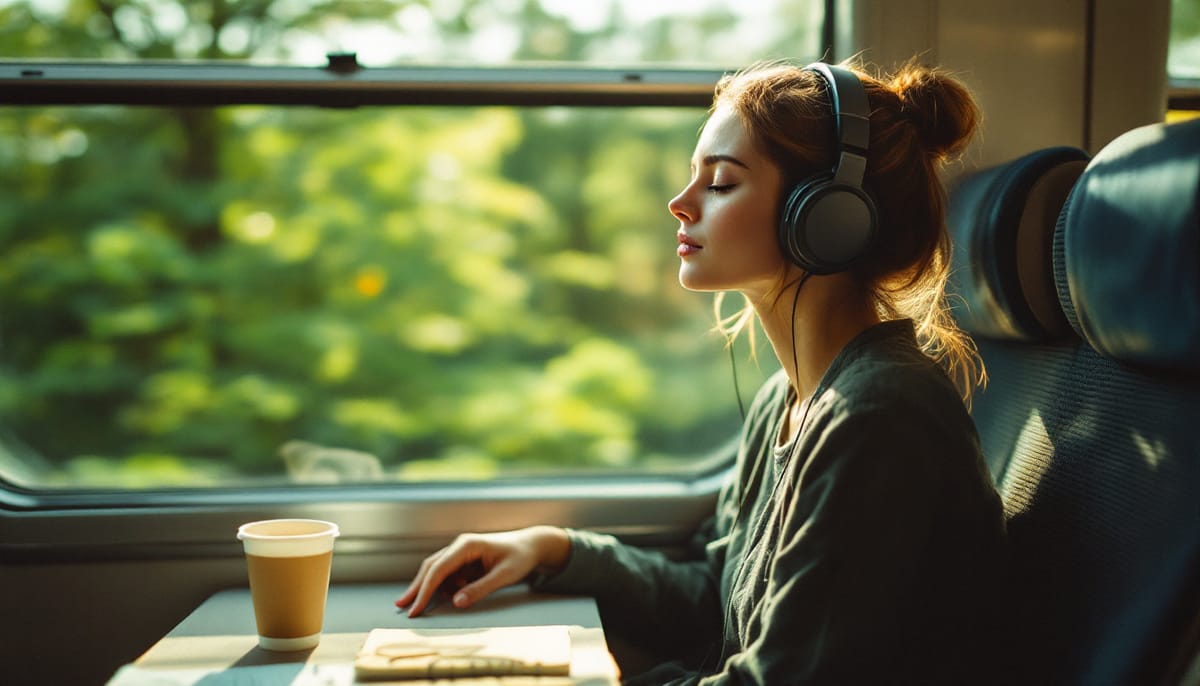
In short — Nomadic relaxation means finding inner comfort wherever you are, using headphones, breathing and a prepared audio session rather than a yoga mat or silent room. It works with the noise and constraints of public transport instead of fighting them, turning the commute into a chosen pause.
The daily commute has a bad reputation. It is described as dead time, a parenthesis endured between home and work, a succession of jolts, noise and crowdedness. And yet, these are often thirty, forty, sometimes sixty minutes that belong to us, offered in the middle of a saturated day. Learning to relax there is no feat: it is a matter of method, attention and well-chosen tools. Nomadic relaxation consists precisely in finding a little inner comfort wherever you are, without a yoga mat or a silent room, with only a pair of headphones, your breathing and a little curiosity as allies.
Why public transport is an underestimated place for relaxation
In a train carriage, a bus or a metro car, we are already in a kind of parenthesis: we cannot really work, cook, or respond to every demand. This constraint becomes an opportunity as soon as we stop fighting it. The commute imposes a framework, a beginning and an end, which helps many people allow themselves a pause they would not take otherwise.
The setting also has obvious drawbacks: ambient noise, changing light, nearby neighbours, announcements. Rather than trying to make these elements disappear, nomadic relaxation suggests working with them. The goal is not absolute silence, but a chosen soundscape that covers without assaulting, a comfortable posture, a gaze that settles elsewhere. This flexibility is the key: it makes relaxation possible even in an imperfect environment, which is ultimately the case for most of our days.
Finally, there is a cultural dimension to cultivate. Travel has long been associated with reading, daydreaming, contemplating the landscape. Nineteenth-century writers already described the train as a thinking machine, where the scrolling of the outside world fosters a particular state of mental availability. Relaxing on public transport means reconnecting with this tradition: making the commute a moment of intimate culture rather than a mere wait.
Preparing your nomadic relaxation ritual before you leave
Relaxation on the move often begins before departure. A few simple preparations change the experience entirely.
- Headphones or earbuds: choose a comfortable model that moderately isolates you from noise without cutting you off from the world. The goal is not to isolate yourself completely, but to create a stable sound bubble.
- A prepared audio selection: avoid searching for what to listen to once seated. Download one or two short sessions in advance so you don't depend on the network.
- A realistic posture: there is no need to aim for the lotus position. Back against the seat, shoulders relaxed, feet flat if possible: that is more than enough.
- An anchoring object: a notebook, a paperback, a photo, a cup of tea on the train. This small ritual signals to the brain that pause time is beginning.
This preparation has a valuable side effect: it creates an intention. You no longer get on the bus enduring the journey; you get on with a plan for calm. This simple shift in perspective already changes the quality of the moment.
Cultural sound relaxation: a bubble of meaning in the hubbub
Among the available tools, cultural sound relaxation holds a special place. It does not merely play soothing background music: it combines a voice, a rhythm and content inspired by literature, music and philosophy. The idea is simple: offer the mind something beautiful and calm to listen to, rather than a stream of information or an impersonal playlist.
In practice, a cultural sound relaxation session can blend a spoken introduction, a text inspired by the world's wisdom traditions, guided breathing and musical passages. The scripts offered are original, written in a spirit of transmission rather than literal quotation: they draw on great traditions of thought without reproducing them word for word. There you find universal themes — patience, simplicity, attention to the present, gentleness toward oneself — that resonate particularly well with the experience of travel.
The advantage in a nomadic situation is considerable. A ten- to twenty-minute session fits into most commutes, requires only headphones, and occupies attention constructively. Where scrolling on a phone tires the eyes and scatters the mind, listening to content designed for relaxation recentres you. Apps like Sonocrea offer this type of session, to be chosen according to the length of the journey and the atmosphere you are looking for.
Choosing the right format for your journey
Not all trips are equal. For a short metro ride, a brief session focused on breathing and a short literary evocation is enough. For a longer train journey, you can opt for a fuller format, with several musical passages and a slightly more developed text. In a car — never while driving, but during a break at a rest area — a session of a few minutes helps you recover before setting off again. This modularity is one of the strengths of nomadic relaxation: it adapts to the time available rather than demanding it.
Three simple exercises to practise seated, without equipment
Even without headphones, it is possible to cultivate relaxation during a journey. Here are three easy-to-remember exercises.
Attention to points of contact
Bring your attention in turn to the places where your body is in contact with the seat: your back against the backrest, your thighs on the seat, your feet on the floor, your hands resting. Take a few seconds for each, without changing anything. This exercise anchors attention in concrete sensations and gently diverts the mind from spinning thoughts.
Lengthened breathing
Without forcing, let the exhalation lengthen slightly, as if you were sighing softly. Count mentally to four on the inhale, to six on the exhale, and repeat about ten times. Nothing spectacular, but this simple rhythm often calms the mind and releases tension in the upper body.
The gaze that settles
Choose a stable point — a detail of the landscape, a line on the carriage wall, the cover of your book — and let your gaze rest there for a few moments. Then close your eyes or lower your eyelids and observe the contrast. This exercise, inspired by contemplative practices, helps you step out of the flow of visual stimuli typical of urban transport.
Creating a sound atmosphere suited to travel
Sound is the traveller's best ally. It still has to be chosen well. Music that is too rhythmic stimulates, a podcast that is too dense tires, total silence is rarely possible. The ideal lies in between: soft textures, calm voices, slow tempos, and above all a certain continuity that covers the irregular noises of transport.
You can also play with the volume: loud enough to mask announcements, low enough to remain aware of your surroundings. This light presence is important, especially in the city where you must stay attentive to what is around you. Nomadic relaxation is not a total disconnection from the world, but an adjustment of your attention.
Finally, remember to vary. A cultural sound relaxation session in the morning to approach the day calmly, a more neutral musical passage in the evening to unwind before heading home. This alternation prevents weariness and gives the commute a pleasant little structure, like a personal ritual that paces the weeks.
Conclusion: making every journey a stopover
Relaxing on public transport requires neither expensive equipment nor special skill. A little intention, a pair of headphones and a few minutes of attention are enough. By turning the commute into a stopover rather than an endured wait, you gain a space of calm in the heart of often busy days. Cultural sound relaxation, with its texts inspired by the world's wisdom traditions and its musical atmospheres, offers an elegant and accessible framework for this daily rendezvous with yourself.
To discover sessions designed for nomadic relaxation, you can explore Sonocrea's offerings, to listen to with headphones during your journeys or during a break. Choose a short format, settle in comfortably, and let the journey become a moment for you: https://sonocrea.com.
Precaution: do not listen while driving; if you have epilepsy or psychiatric disorders, ask a doctor's advice.
Frequently asked questions
How can I relax on public transport without equipment?
You can practise attention to points of contact, lengthened breathing with a longer exhale, or resting your gaze on a stable point. These simple seated exercises need no headphones or mat and help calm the mind during a journey.
What is cultural sound relaxation?
It combines a voice, a rhythm and content inspired by literature, music and philosophy. Rather than soothing background music alone, it offers the mind something beautiful and calm to listen to, with original scripts drawing on universal themes such as patience and attention.
How long should a relaxation session be for a commute?
A ten- to twenty-minute session fits into most commutes. For a short metro ride, a brief session focused on breathing and a short literary evocation is enough; for a longer train journey, a fuller format with several musical passages works well.
Read also
Découvrez Sonocrea
Créez vos propres séances de bien-être sonore avec notre IA. Fréquences binaurales, hypnose audio et sons ambiants personnalisés.
Essayer gratuitement →