Evening Ragas: Time and Hour in Indian Music
Evening ragas show how Indian music ties each hour to its own sonic colour. A guide to twilight and night ragas, and to listening with calm attention.
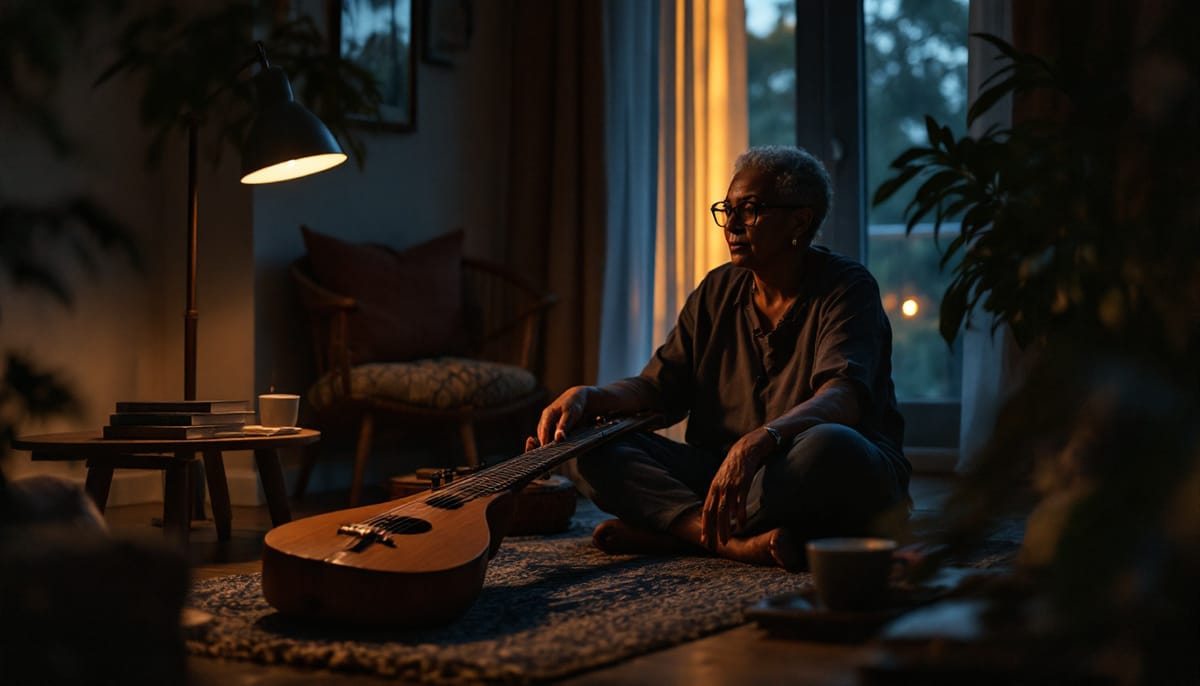
In short — Evening ragas are frameworks in Indian classical music associated with specific hours, especially twilight and the night. Listening to a raga at the hour that suits it is part of the experience, a form of courtesy toward the music and a way of settling down at the end of the day.
In Indian music, there is a simple and dizzying idea: every hour of the day has its own sonic color. Evening ragas are not merely an end-of-day playlist; they form a system in which time is a musical material in its own right. At Sonocrea, a cultural sound relaxation app, we love exploring these correspondences between the hour, the light, and listening. Here is how Indian tradition thinks about the evening, and what that thinking can offer anyone seeking to slow down.
What is a raga, and why does time matter in it?
A raga is not a fixed melody. It is a framework: a scale of notes, patterns of movement, a way of ascending and descending, a hierarchy among sounds. In the classical music of North India (Hindustani) as in that of the South (Carnatic), this framework is associated with a moment of the day, or even a season. We speak of morning ragas, afternoon ragas, night ragas.
This association is not decorative. It rests on a fine observation of atmosphere: the light that fades, the heat that falls away, the sounds that change. The musician does not "describe" the evening; they offer a form that seems to them attuned to that hour. The Indian musician and pedagogue Vidya Rao has often explained how much listening this discipline demands even before playing. Her contemporary, the singer Kumar Gandharva, likewise defended an approach in which the raga is thought of in relation to place and moment, rather than as an isolated object.
For today's listener, remembering just one thing is enough: in this tradition, listening to a raga at the right moment is part of the experience. It is a form of courtesy toward the music, and a way of attuning oneself to the weather of time.
Twilight ragas: between transition and restraint
The pivotal moment, in Indian theory, is the passage from day to night. Several ragas are attached to it, and they share a characteristic: a certain restraint. One often finds hesitant notes, phrases that seem suspended, a gentle tension between what is ending and what is beginning.
The raga Yaman, one of the best known, is frequently associated with the beginning of the evening. Its particular color, with a raised note that gives it a singular light, makes it a classic companion of the first nocturnal hours. The raga Purvi, closer to sunset, is reputed to be more grave, more dense. The raga Marwa, often placed at the hinge, plays on a form of controlled unease.
This gradation recalls other traditions that think of the night in stages. In the Arab and Persian world, maqams and dastgahs have long been associated with moments of the day or states of mind, and ancient treatises, such as those of the Persian scholar al-Farabi, discuss the effect of time on interpretation. In West Africa, griot repertoires also organize pieces according to occasion: a morning praise song does not look the same as an evening vigil song. Everywhere, music serves to mark passage.
Evening, night, and the question of the late hour
Indian tradition does not stop at twilight. It distinguishes several moments of the night, with ragas dedicated to the deep hours. Some are reputed for their gravity, others for a form of ample gentleness. The raga Malkauns, often placed late in the night, is famous for its sobriety: few notes, but considerable weight. The raga Bageshri, for its part, is frequently associated with the end of the evening, with a more tender color.
Here we must be precise: these associations vary according to schools, regions, and families of musicians. There is no single, universal table. The musician Sheila Dhar, in her writings on Indian musical life, described with finesse how alive the rules are, negotiated, transmitted orally. Her colleague and singer Dinkar Kaikini likewise insisted on the part of personal interpretation within respect for the framework.
For relaxed listening, the important thing is therefore not to verify the exact hour of a raga, but to grasp its intention: a music that accepts the night instead of fighting it.
What the poetry of evening teaches us about listening
Indian music is inseparable from sung poetry. Thumris, bhajans, and ghazals carry texts in which evening is a character: waiting, absence, confidence. The poet and singer Mirabai, whose compositions are still sung today, left texts in which the night becomes an intimate space. The South Indian poet and musician Andal, for her part, inscribed song within precise moments of the day. Their male counterparts, such as the poet Tulsidas or the composer Tyagaraja, also wrote for determined hours.
This alliance of text and hour is found elsewhere. In Japan, classical poetry associates seasons and moments with precise images, and Noh theater organizes its performances according to a temporal progression. Among the Indigenous peoples of North America, many vigil songs accompany nightfall with words that name the landscape. In Europe, the Nocturnes of the pianist and composer Maria Szymanowska, like those of John Field, explore an intimate night, without ever dramatizing it.
For our practice of cultural sound relaxation, the lesson is clear: a murmured text, a slow musical phrase, a well-kept silence can be enough to establish an evening atmosphere. No need for spectacular effects.
How to listen to evening ragas today, without folklore
It is not about reconstructing a ritual or claiming to reproduce a sacred practice. It is about listening attentively, with knowledge of the context. A few concrete markers:
- Choose the right moment. A twilight raga is best heard when the light is actually fading. This can be as simple as a dimmed lamp.
- Favor quality recordings. Indian music relies on micro-intervals; excessively compressed sound crushes them.
- Listen without multitasking. A few minutes are enough. The goal is comfort, not performance.
- Alternate voices. The great female and male voices of the tradition offer complementary approaches: listening to several interpreters of the same raga is instructive.
- Complement with other traditions. An evening maqam, a vigil song, a European nocturne: comparison sharpens the ear.
At Sonocrea, we offer original scripts inspired by the wisdom of the world, some of which draw on this Indian idea of music attuned to the hour. They are written to be read or listened to at one's own pace, without any promise of results: just a benevolent framework for settling down at the end of the day.
Conclusion: evening as an invitation to listen
Evening ragas remind us of an obvious truth we often forget: music is not only a matter of notes, it is also a matter of moment. To listen to a raga at the hour that suits it is to accept that time has a texture. This idea runs through cultures, from India to the Persian world, from West Africa to Japan, and all the way to the European salons of the 19th century. It requires neither belief nor special equipment: only a little availability.
If you would like to explore this approach in a soothing setting, discover Sonocrea's cultural sound relaxation sessions at https://sonocrea.com. Take the time to try, at the hour that suits you.
Precaution: do not listen while driving; in case of epilepsy or psychiatric disorders, seek medical advice.
Frequently asked questions
What is an evening raga?
An evening raga is a framework of notes and patterns in Indian classical music associated with twilight or the night hours. Ragas such as Yaman, Purvi and Marwa are linked to the passage from day to night, often with a certain restraint.
Why does time matter in Indian music?
In Indian tradition, each raga is associated with a moment of the day or a season. This association rests on observation of atmosphere, light and sound, and listening at the right moment is considered part of the experience.
How can I listen to evening ragas today?
Choose the moment when light is actually fading, favour quality recordings because micro-intervals matter, listen without multitasking, and compare several interpreters of the same raga. A few minutes are enough; the goal is comfort, not performance.
Read also
Découvrez Sonocrea
Créez vos propres séances de bien-être sonore avec notre IA. Fréquences binaurales, hypnose audio et sons ambiants personnalisés.
Essayer gratuitement →