The Arabian Nights: The Art of the Evening Tale
The Arabian Nights show how a voice and a suspended story can slow time. Explore the art of the evening tale and how to build a calming storytelling ritual.
In short — The Arabian Nights embody the art of the evening tale: a voice, a story left suspended and the desire to know what comes next. This slow, nested storytelling inspires cultural sound relaxation sessions that blend literature, music and silence for comfort and calm.
There is an hour when the world consents to slow down: the hour of the evening tale. Long before screens, evening gatherings told the world in hushed voices, and the Arabian Nights remain one of its finest examples. This collection, born from an interweaving of Arab, Persian and Indian oral traditions, has crossed the centuries while constantly transforming itself. Its art rests on very little: a voice, a story left suspended, the desire to know what comes next. It is precisely this art that Sonocrea explores through its cultural sound relaxation, where literature, music and philosophy compose a moment of comfort and ease.
An architecture of storytelling that holds back time
The structure of the Arabian Nights is a masterpiece of patience. A storyteller, Scheherazade, engages her own story within the one she tells: each night opens with a tale, which contains another, which sometimes contains a third. This device, called a story within a story, creates a singular experience: one does not seek the end, one savors the path.
This architecture has cousins almost everywhere in the world. In the Indian epic of the Mahābhārata, the tales nest within one another as well, carried by successive narrators. In West Africa, the griots of the Manding tradition build their epics in episodes, adjusting the rhythm to the audience. In Japan, rakugo storytellers hold their audience with a punchline prepared with clockmaker's precision. Everywhere, the same intuition: the evening tale is not a race toward the conclusion, but a habitable space.
For a practice of relaxation, this lesson is precious. A cultural sound relaxation session does not need to go fast. It can set a scene, describe an object, let a voice be heard, then let a silence breathe. Slowness is not a flaw: it is the very material of comfort.
The voice, the first instrument of the evening
In traditional evening gatherings, the voice does everything. It modulates, hesitates, amuses itself, becomes grave for a king and light for a bird. This vocal science is found among storytellers of many cultures: the ḥakawātī of the cafés of the Arab world, long exclusively male before women took up the torch; the storytellers of Berber evening gatherings in the Maghreb, who pass down tales from generation to generation; the tale-tellers of Andean villages, where speech is sometimes accompanied by a small drum.
In Europe, the oral tradition also has its great voices. The tales collected by the Brothers Grimm in Germany, like those gathered by the Scottish writer and folklorist Francescina… pardon, by the Scottish writer Frances Browne or by the Irish collector Lady Gregory, show how much the transmission of the tale was often the work of women. Today, contemporary storytelling stages bring together artists such as the Franco-Algerian storyteller and male voices of the new generation, in a continuous dialogue.
For sound relaxation, this diversity of timbres is a richness. A voice close to a whisper, a slightly irregular rhythm, pauses longer than expected: these details create an atmosphere of trust. Sonocrea relies on this simple idea: a steady voice and a well-chosen text are worth more than a continuous stream of information.
What evening tales transmit without teaching
The Arabian Nights do not give lessons. They tell of merchants, fishermen, birds that speak, distant cities. And yet something passes: a way of listening, of suspending one's judgment, of letting a story deposit an image within oneself.
This indirect transmission is found in other traditions. The Buddhist Jātaka tales, in India and Sri Lanka, tell of animal and human lives to invite reflection, without ever delivering a moral. In China, the zhiguai tales, these "tales of the strange" compiled as early as the 3rd century, blend the everyday and the marvelous with a sobriety that leaves the reader free. Among the Indigenous peoples of North America, evening tales transmit knowledge about the seasons, animals and the bonds between beings, often in the form of stories where humor holds a central place.
For a moment of well-being, this approach is precious: no message to remember, no goal to reach. One can listen to a story as one watches a fireplace. Relaxation comes from this absence of demands.
Music and ambiences: composing a sonic setting
The evening tale has always needed a setting. In evening gatherings, this setting could be the crackling of the fire, the wind, the distant sound of animals. Today, it can be a discreet musical layer, an acoustic instrument, a breath of percussion.
The musical traditions of the world offer an infinite repertoire to accompany a tale. The oud and the ney of the Arab world, the kora and the balafon of West Africa, the Chinese guqin with its muted tones, the Indian santoor or the Andean harp: each instrument brings a color, a breath. The important thing is not to accumulate, but to choose a texture that leaves the voice in the foreground.
In this logic, a cultural sound relaxation session can alternate: a short spoken introduction, a musical passage, a tale inspired by a tradition, then a return to silence. This alternation, close to the structure of evening gatherings, allows attention to settle without effort. The original scripts offered in this context draw on the wisdom of the world without ever reproducing a modern translation word for word: they keep its spirit, not its letter.
Establishing your own evening ritual
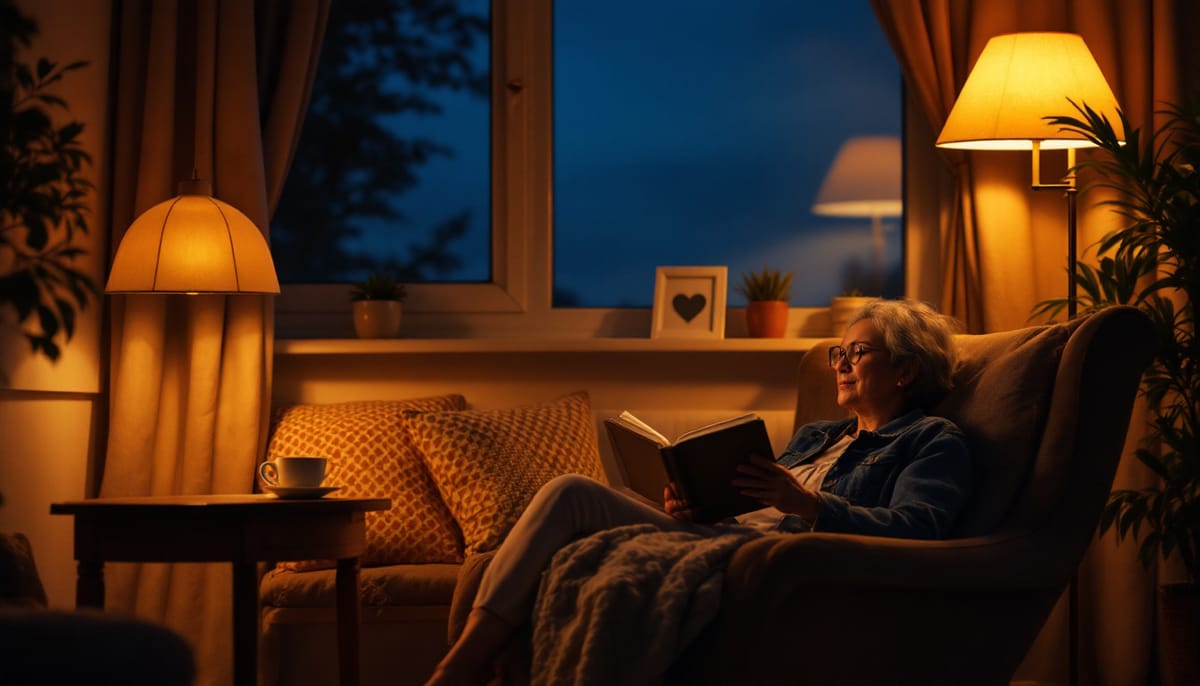
No need for a palace or an oil lamp. An evening tale ritual can fit into an armchair, a soft light and twenty minutes of calm. Here are a few concrete reference points, to adapt freely.
- Choose a stable hour: the brain likes reference points. The same time slot, even a short one, establishes a habit of relaxation.
- Lower the light: dimmed light helps the body understand that the day is ending.
- Prepare a short text: a tale, an excerpt, an invented story. Brevity is not a flaw.
- Alternate tale and silence: a few seconds of pause after an important sentence are enough to create space.
- Avoid the screen: prefer a recorded voice or reading aloud, so as not to strain the eyes.
These reference points can be combined with a sound relaxation app such as Sonocrea, which offers sessions blending texts, music and ambiences. The idea remains the same: to offer body and mind a moment of comfort, without performance or goal.
One can also vary the sources. One evening, a tale from the Arabian Nights; another, a story from the Haitian oral tradition, where tales often begin with an opening formula that invites the audience to respond; another still, a European philosophical narrative, like those found in Epictetus or in the philosopher and mathematician Hypatia, whose oral teaching marked her era. This variety sustains curiosity and avoids routine.
An art of attention, not of escape
The evening tale is not a way of escaping the world: it is a way of holding oneself in it differently. The Arabian Nights speak of power, justice, cunning, generosity. They tell of human societies with their tensions and their joys. To listen to a story is to accept looking at the world through other eyes, without rushing to conclude.
This quality of attention is cultivated. It comes close to what the philosophers of ancient Greece called prosokhē, a sustained attention to the present moment, and to what the contemplative traditions of East Asia describe as a simple presence in daily life. Nothing mysterious: just an availability. And that is perhaps the finest gift an evening tale can offer.
Whether you prefer tales of kings, animal stories or travel narratives, the essential thing is to find the voice that suits you. To extend this discovery, explore the cultural sound relaxation sessions of Sonocrea: original texts, chosen music and ambiences designed for evening comfort. Settle in, turn off the main light, and let a story take the time to come to you.
Precaution: do not listen while driving. In case of epilepsy or psychiatric disorders, ask a doctor's advice.
Frequently asked questions
What is the story-within-a-story structure of the Arabian Nights?
Scheherazade tells a tale each night that contains another, sometimes a third. This nesting, called a story within a story, means the listener savours the path rather than seeking the end.
How can I create an evening storytelling ritual for relaxation?
Choose a stable hour, lower the light, prepare a short text and alternate tale with silence. Avoid screens and prefer a recorded voice or reading aloud, so the eyes can rest.
Why is slowness important in an evening tale?
The evening tale is not a race toward the conclusion but a habitable space. Pauses, a steady voice and a well-chosen text create an atmosphere of trust and comfort without any demand or goal.
Read also
Découvrez Sonocrea
Créez vos propres séances de bien-être sonore avec notre IA. Fréquences binaurales, hypnose audio et sons ambiants personnalisés.
Essayer gratuitement →