Oum Kalthoum: The Suspended Time of Egypt's Great Voice
Oum Kalthoum's voice stretches time through the qasid and patient repetition. Explore how her art, and other world traditions, can inspire a calm listening ritual.
A voice that stretches time
There are voices that do not merely sing: they change our relationship with duration. Oum Kalthoum (around 1904-1975), nicknamed "the Star of the East," holds a singular place in the musical memory of the Arab world. Born in a village in the Nile Delta, she grew up learning the religious repertoire from her father, then crossed the twentieth century to become a central figure of Egyptian radio, cinema and stage. To listen to her recordings is to experience time opening up: the songs last, repeat, unfold, and the listener accepts to slow down.
In this article, we explore what this particular kind of listening can offer our attention, with no medical promise and no magic formula. The cultural sound relaxation offered by Sonocrea follows this approach: drawing on works, texts and stories to create moments of calm, rooted in a history and a sensibility.
The qasid and the tariqa: the art of patient repetition
To understand Oum Kalthoum, one must grasp the form of the qasid, that long sung poem in which the text is taken up, modulated, extended. Far from the short song, the qasid establishes a generous duration: one returns to a line, changes its colour, lets the phrase breathe. This principle of slow repetition is not unique to Egypt. It is found in the recitation of dhrupad in North India, where the text unfolds over long temporal architectures, and in the Iraqi maqâm, a learned vocal art passed from master to pupil.
This patience is not monotony: it is a way of inhabiting a text. The Indian philosopher and poet Lalla Ded, in the Kashmiri tradition, and the Arab poet Al-Khansa, in the seventh century, both compose with repetition and memory. Their works, transmitted orally, remind us that repeated speech becomes a familiar place, almost a refuge. Among men, the pre-Islamic poet Imru' al-Qais and the Persian thinker Rumi also built works in which the return of formulas creates an inner rhythm.
For a practice of relaxation, this lesson is precious: to accept repeating, returning, without seeking novelty at all costs. It is one of the principles behind Sonocrea's original scripts, inspired by the wisdom traditions of the world and designed to accompany slow breathing.
The voice as a place of listening: a shared heritage
Oum Kalthoum sang for a long time, and her concerts lasted for hours. The audience came for that duration, not in spite of it. This temporal generosity is found in several traditions: the griot of West Africa, such as the singer and storyteller Sira Moussa in Mandinka memory, unfold stories over several hours; in Japan, nô theatre moves at an extremely slow pace, and the singer Izumi Shikibu, a court poet, left verses whose very slowness is the subject. In Europe, the composer Hildegard of Bingen wrote liturgical chants in which the musical phrase stretches out, while the composer Arvo Pärt today explores a stripped-down musical time.
What links these examples is not a mysterious "energy" but an artistic choice: that of giving the listener the right to settle in. The voice then becomes a space, not a message to be decoded. In a practice of sound relaxation, one can draw on this idea: to listen without expecting, to let the sound occupy the room.
An embodied listening, not decorative
It is not about using Arabic music as an exotic background sound. It is about recognising an aesthetic: that of tarab, that emotion shared between performer and audience, described by musicologists of the Arab world. Tarab is not a therapy; it is a cultural experience of communion, in which one accepts being moved by a musical phrase. This honesty of listening is at the heart of the Sonocrea approach: culture first, comfort afterwards.
What the great voice teaches our attention
To listen to Oum Kalthoum today is to accept a rhythm that is not that of notifications. Three concrete lessons emerge:
- Duration as a choice. Taking fifteen minutes for a single song, doing nothing else, is already a practice of presence. One can alternate with long pieces from other traditions: an Indian raga, an instrumental taqsim, a European suite for viola da gamba.
- Repetition as familiarity. Listening to the same passage several times does not impoverish the experience; it creates a landmark. Storytellers of the oral tradition, in West Africa as among the Indigenous peoples of North America, have known this for a long time.
- The human voice as an anchor. A sung voice, even if linguistically not understood, offers a reassuring texture. One can compare it to reading a poem aloud: Sappho in ancient Greece, Bashō in Japan, Sor Juana Inés de la Cruz in Mexico, all of them play on this closeness.
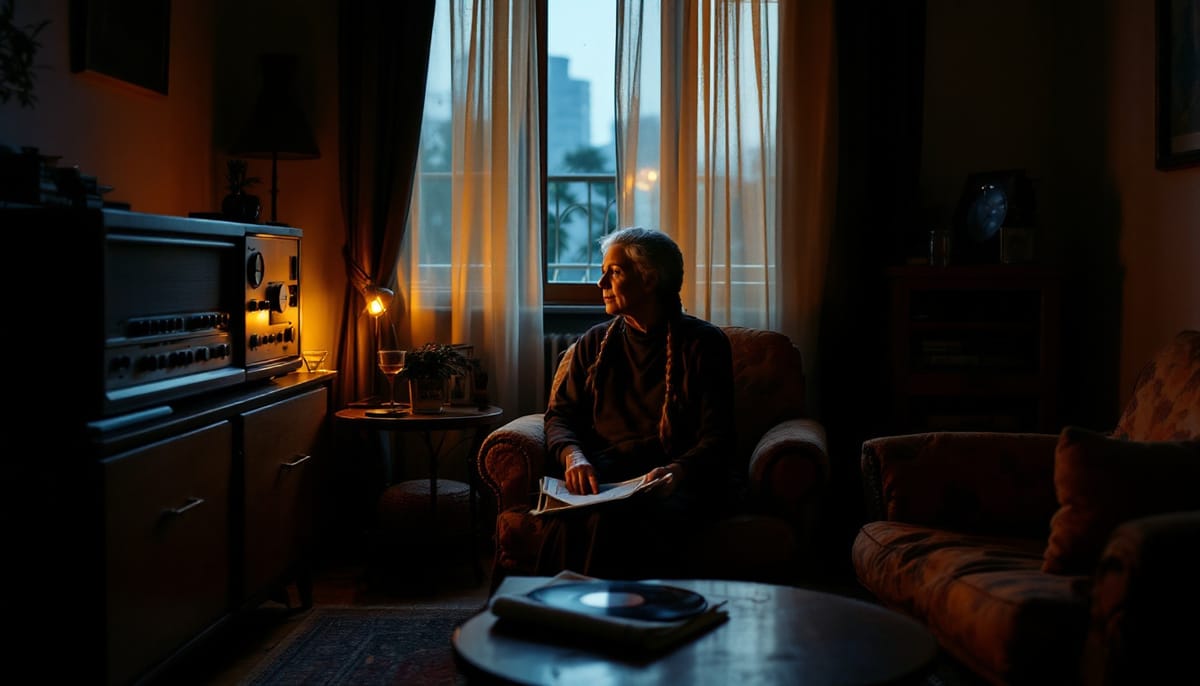
In a simple scenario: a person comes home after a dense day, settles into an armchair, chooses a long recording, and lets the voice occupy the space. Another prefers to walk slowly while listening to a sung poem. There is no single rule: the essential thing is to choose a calm setting and to respect one's own rhythm.
Building a cultural and caring listening ritual
Cultural sound relaxation is not a recipe; it is an attention paid to what one listens to. Here are a few concrete reference points, with no promise of results:
- Choose a work and stick with it. A qasid by Oum Kalthoum, a dhrupad chant, a Sami lullaby from Scandinavia: coherence helps one enter into duration.
- Prepare the space. Soft light, phone on silent, comfortable position. Nothing spectacular: comfort is enough.
- Welcome thoughts without fighting them. The voice continues, attention returns. It is gentle training, not a performance.
- Alternate cultural areas. Listening to the Arab tradition one week, an Indonesian gamelan or an Inuit chant the next, feeds curiosity and prevents weariness.
Sonocrea's original scripts are inspired by these wisdom traditions of the world — Arabic poetry, Persian tales, Native American stories, Greek philosophy — without ever reproducing a sacred ritual or quoting a modern translation word for word. The goal is modest and clear: to offer a pleasant setting for slowing down.
Conclusion: suspending, not escaping
Oum Kalthoum does not invite us to flee the world: she invites us to change its speed. Her voice, like those of storytellers from many traditions, reminds us that attention is a common good, to be cultivated with respect and curiosity. Listening at length, repeating, letting the musical phrase breathe: here is a simple practice, culturally rooted, that can find a place in an ordinary day.
To extend this discovery, explore the soundscapes and stories of Sonocrea, the cultural sound relaxation app, and compose your own listening ritual, at your own pace.
Caution: do not listen while driving; in case of epilepsy or psychiatric disorders, seek medical advice.
Frequently asked questions
What is the qasid in Oum Kalthoum's music?
The qasid is a long sung poem in which the text is taken up, modulated and extended. Rather than a short song, it establishes a generous duration, letting a line breathe and return, which is central to Oum Kalthoum's art.
How can I build a listening ritual inspired by Oum Kalthoum?
Choose one long work and stay with it, prepare a calm space with soft light and a silent phone, welcome thoughts without fighting them, and alternate cultural areas over time. The aim is comfort and attention, not performance.
Read also
Découvrez Sonocrea
Créez vos propres séances de bien-être sonore avec notre IA. Fréquences binaurales, hypnose audio et sons ambiants personnalisés.
Essayer gratuitement →