Balinese and Javanese Gamelan: Music That Weaves Time
The gamelan of Java and Bali turns and layers sound rather than rushing to a conclusion. Here is how to listen to it slowly, and how it can anchor a cultural sound relaxation.
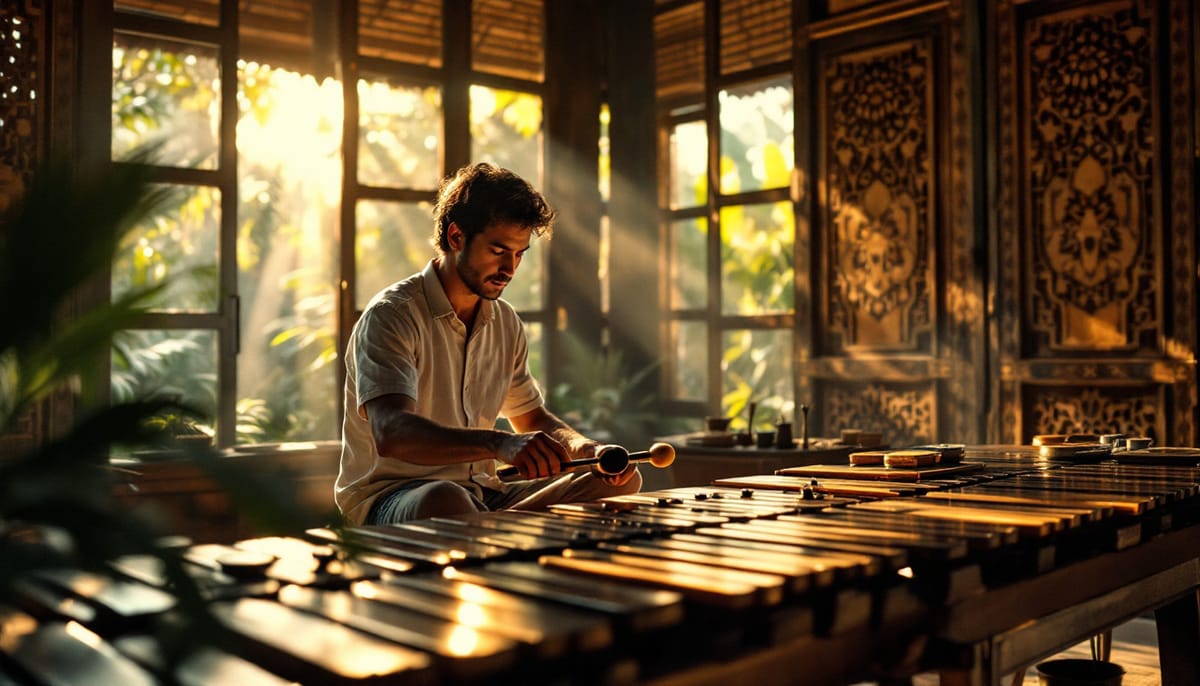
In short — The gamelan is an orchestra of bronze and bamboo from Java and Bali whose music is cyclical rather than narrative, layering motifs over deep gong cycles. Listening to it slowly, following the gong, the high bars and the drum, offers a calm space rooted in a respected tradition.
Some music does not tell a linear story but instead establishes a place. The gamelan, an orchestra of bronze and wood born in Java and Bali, belongs to this rare family: its music does not rush toward a conclusion; it turns, returns, layers upon itself, and ultimately gives time an almost tangible texture. For anyone seeking to slow down, to listen differently, it is a precious gateway — that of a cultural sound relaxation, rooted in a precise and respected tradition.
What is a gamelan?
The word refers both to the instrumental ensemble and to the music it plays. A gamelan brings together metallophones (saron, gender, suspended gongs), drums (kendang), bamboo flutes (suling), and sometimes voices. The bronze bars are tuned in pairs slightly out of tune with each other: from this tiny beat arises a characteristic undulation, a shimmer that seems to breathe.
Two main families are generally distinguished. The Javanese gamelan, refined and slow, associated with the princely courts of Yogyakarta and Surakarta, favors gentleness and meditation. The Balinese gamelan, livelier and denser, accompanies ceremonies and dances, with striking displays of speed. In both cases, the ensemble functions as a collective organism: no one "shines" alone; each musician holds a fragment of a shared melody.
Music that weaves time
Listening to gamelan first unsettles the Western ear accustomed to harmonic progression. Here there is no tension toward a final point: the structure is cyclical. A deep gong marks the great breaths, the middle instruments embroider, the highest ornament. Time unfolds in concentric circles, like the patterns of a batik cloth being unrolled.
This conception connects with other traditions around the world. In the classical music of North India, the raga unfolds according to an hour of the day and a slowness of its own, without haste. Among the Fulani musicians of West Africa, the solo flute establishes a space where silence weighs as much as sound. In Europe itself, the medieval Ars nova already played with repetition and ostinato. The gamelan is therefore not an exotic curiosity: it is one of the great human ways of taming duration.
Women hold an important place within it, often discreet in tourist accounts. In Bali, women's gong kebyar ensembles have long existed; in Java, the singers (pesinden) carry a large part of the repertoire, and teachers such as the women musicians of the Surakarta conservatories pass on a demanding body of knowledge. On the European side, the composer Claude Debussy, at the 1889 World's Fair, was struck by Javanese sonorities; the composer and educator Lou Harrison, in the United States, devoted part of her work to a dialogue with these timbres. These exchanges show a mutual curiosity, never mere imitation.
Listening to gamelan as one reads a poem
The Javanese tradition often associates music with sung poetry; the tembang unfold verses over slow melodies. One can draw inspiration from this without reproducing anything: to listen to a gamelan is to accept not understanding everything, to let the layers settle. Three simple attitudes help:
- Choose an anchor point: first follow the deep gong, then the high bars, then the drum.
- Welcome repetition: do not wait for the "new," but savor the tiny variation of the same motif.
- Let silence be: between two cycles there are pauses, and they are part of the music.
This way of listening connects with what storytellers in many cultures call "entering the time of the tale": in India, the slow recitation of the Ramayana; in the Maghreb, the evening gathering where the voice of a popular Scheherazade stretches out the night; in Japan, the slowness of nō. Each time, sound creates a space where the body settles.
Gamelan in a practice of sound relaxation
In a cultural sound relaxation session, the gamelan can serve as a guiding thread: one listens to it in full, without commentary, then lets a short text come, inspired by the world's wisdom traditions, never recited word for word from a translation. An original script can evoke a bamboo garden, a gong calling for slowness, a slow walk between rice fields — concrete, sensory images, without mystical symbolism.
The Sonocrea app offers this kind of approach: sound relaxation sessions rooted in literature, music, and philosophy, where one discovers worlds such as the gamelan alongside other traditions. There, a composed voice, silences, and instrumental excerpts alternate, in a spirit of cultural curiosity rather than performance. A listener from Lyon says she found there "another way to inhabit half an hour"; a listener from Montreal comes for "the pleasure of learning while relaxing." These responses capture the essentials: comfort, curiosity, well-being.
For personal practice, a few guidelines suffice: a moderate volume, a comfortable seated or lying position, a duration of fifteen to thirty minutes, and the desire to return several times to the same recording in order to perceive its details. Repetition is not laziness: it is the very principle of this music.
A living heritage, to listen to with respect
The gamelan is not a backdrop: it accompanies ceremonies, weddings, dances, and rites of passage. Listening to it outside its context is legitimate, provided one names its origin — Java and Bali, Indonesia — and does not reduce it to an "ambience." UNESCO has inscribed the gamelan in the intangible cultural heritage, a recognition of a know-how of craftsmanship, tuning, and oral transmission.
This attention connects with the one owed to other traditions: the Mandinka kora of West Africa, the santur of the Persian world, the Chinese guzheng, the harp of the Andes. Each has its rules, its masters and mistresses, its contexts. To name them precisely is already a form of listening.
Conclusion
The Balinese and Javanese gamelan reminds us that music can be a place rather than a narrative: a space of bronze and bamboo where time is woven slowly. To listen to it is to offer oneself a parenthesis of calm and to discover a culture of rare richness. To extend the experience, discover the cultural sound relaxation sessions of Sonocrea: original journeys, inspired by the music and philosophies of the world, to be savored without rushing.
Precaution: do not listen while driving; in case of epilepsy or psychiatric disorders, seek medical advice.
Frequently asked questions
What is the difference between Balinese and Javanese gamelan?
The Javanese gamelan, refined and slow, is linked to the princely courts of Yogyakarta and Surakarta and favours gentleness and meditation. The Balinese gamelan is livelier and denser, accompanying ceremonies and dances with striking displays of speed.
How should I listen to gamelan music?
Choose an anchor point, first the deep gong, then the high bars, then the drum. Welcome repetition rather than waiting for something new, savouring tiny variations of the same motif, and let the pauses between cycles be part of the music.
Can gamelan be used for relaxation?
In a cultural sound relaxation session, gamelan can serve as a guiding thread: one listens without commentary, then a short original text inspired by the world's wisdom traditions follows. A moderate volume, a comfortable position and fifteen to thirty minutes are enough.
Read also
Découvrez Sonocrea
Créez vos propres séances de bien-être sonore avec notre IA. Fréquences binaurales, hypnose audio et sons ambiants personnalisés.
Essayer gratuitement →